
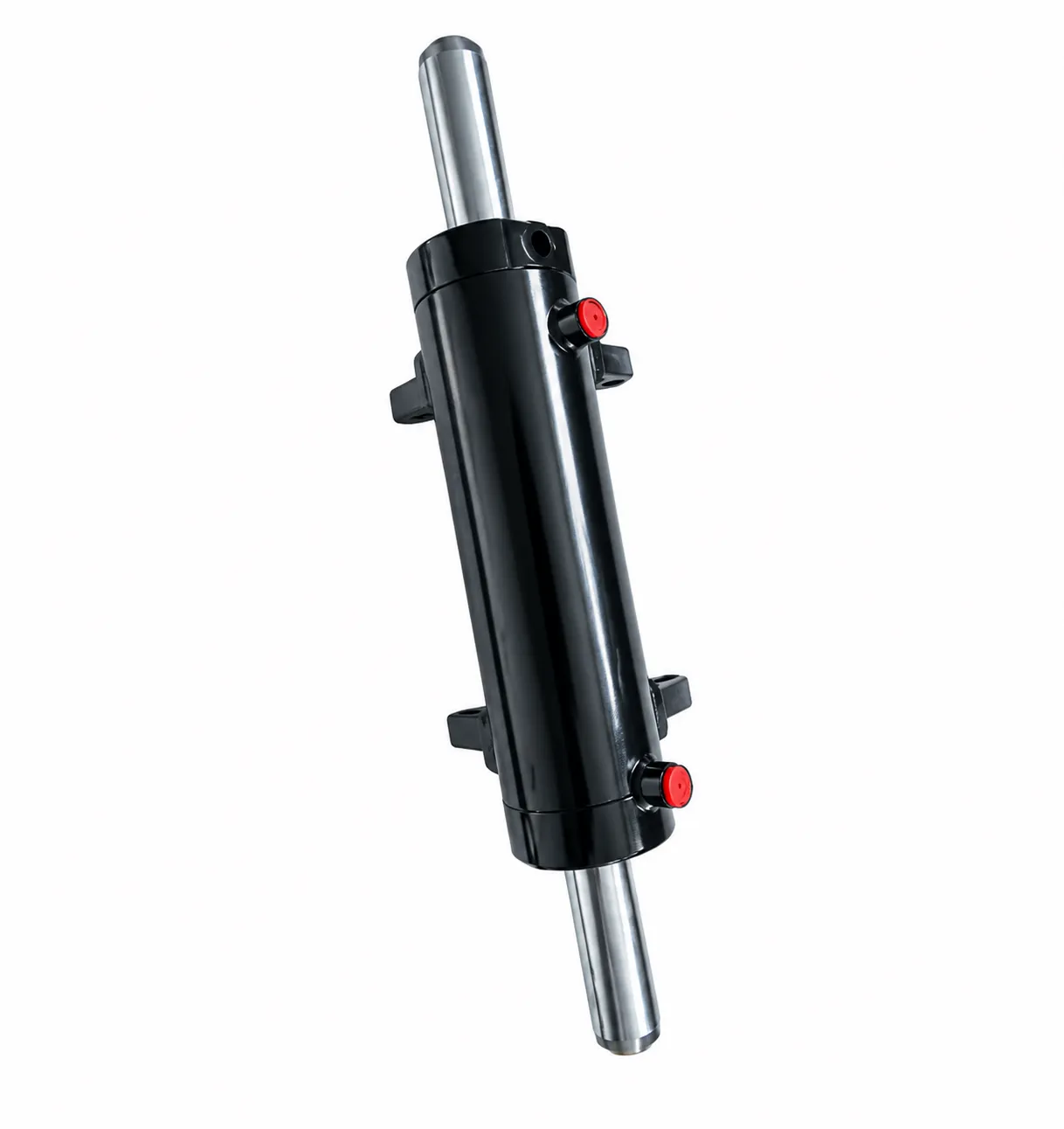
 The agricultural industry across the United Kingdom is undergoing one of its most significant mechanical transformations in a generation. From the flat, open stretches of Lincolnshire to the rolling hills of Yorkshire, farmers and agri-businesses are rapidly adopting GPS-guided tractors, autonomous sprayers, and robotic harvesting platforms. At the mechanical heart of virtually every one of these machines sits a component that often receives far less attention than it deserves: the steering cylinder. This hydraulic actuator is the physical translator between digital commands and real-world wheel movement — the bridge between software precision and soil-level accuracy.
How a Steering Cylinder Actually Works in Autonomous Ag Systems
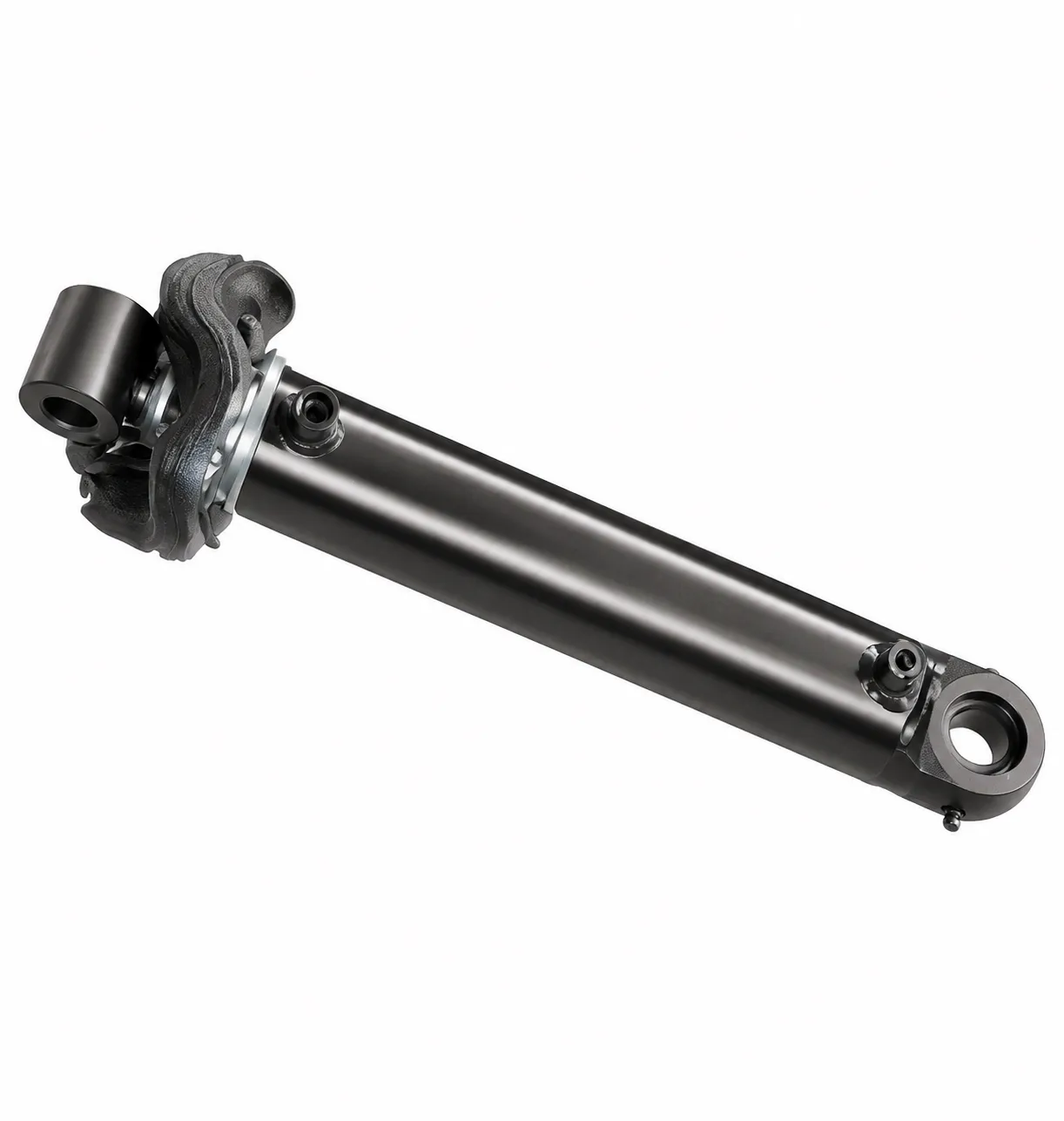 The operational logic of a steering cylinder in an autonomous agricultural platform begins the moment the machine’s GNSS receiver detects a positional deviation from the planned field path. The onboard controller — typically running an ISOBUS-compatible guidance module — calculates the corrective steering angle required and signals the electrohydraulic valve stack to route pressurised fluid into one of the cylinder’s working chambers.
Inside the cylinder body, this pressurised fluid acts on the piston face, generating a linear thrust force proportional to both the operating pressure and the effective piston area. This force travels through the cylinder rod to the steering knuckle or drag-link assembly, physically pivoting the wheel or axle to the commanded angle. Simultaneously, fluid on the opposite side of the piston is returned to the reservoir through the return port, completing the circuit.
What distinguishes an autonomy-grade steering cylinder from a standard unit is the integration of position feedback — typically a magnetostrictive linear transducer embedded within or mounted alongside the cylinder. This sensor continuously reports the exact rod extension to the controller, closing a real-time feedback loop that prevents overshooting and enables sub-centimetre path corrections at field speeds up to 12 km/h. The entire actuation cycle, from signal to physical wheel movement, occurs within 80 to 120 milliseconds in well-designed systems — a speed that is simply not achievable with mechanical steering linkages alone.
Core Materials That Make the Difference
Cylinder Barrel
ST52 seamless cold-drawn steel tube, honed to Ra 0.2–0.4 µm internally. Provides the pressure containment envelope and the precision bore surface against which seals run.
Piston Rod
CK45 or 42CrMo4 alloy steel, induction hardened to 55–60 HRC, then hard chrome plated 20–30 µm. Delivers the bending strength and corrosion resistance required in muddy field conditions.
Seal Package
PTFE-loaded polyurethane rod seals combined with HNBR piston seals. Rated to -30°C for early-morning UK harvesting starts and sustained operating pressures up to 250 bar.
End Caps & Mounts
Ductile iron GGG40 or S355 structural steel, machined to H7 tolerance clevis and eye-end profiles. Optional stainless A4-316 for high-humidity coastal farmland applications.
The choice of materials is not simply a cost exercise — it is a reliability calculation. Agricultural autonomy systems operate over multi-year return-on-investment timescales, meaning that a steering cylinder fitted to a GPS-guided sprayer on a Cambridgeshire arable holding in spring must still be performing with the same dimensional accuracy three or four seasons later. The combination of hardened chrome-plated rod steel, precision-honed barrel bore, and thermally stable seal compounds is the engineering answer to this challenge. Every material selection in a well-specified steering cylinder is driven by the field conditions these machines actually encounter: fine sandy soils, heavy clay, near-constant vibration, dust, and rain.
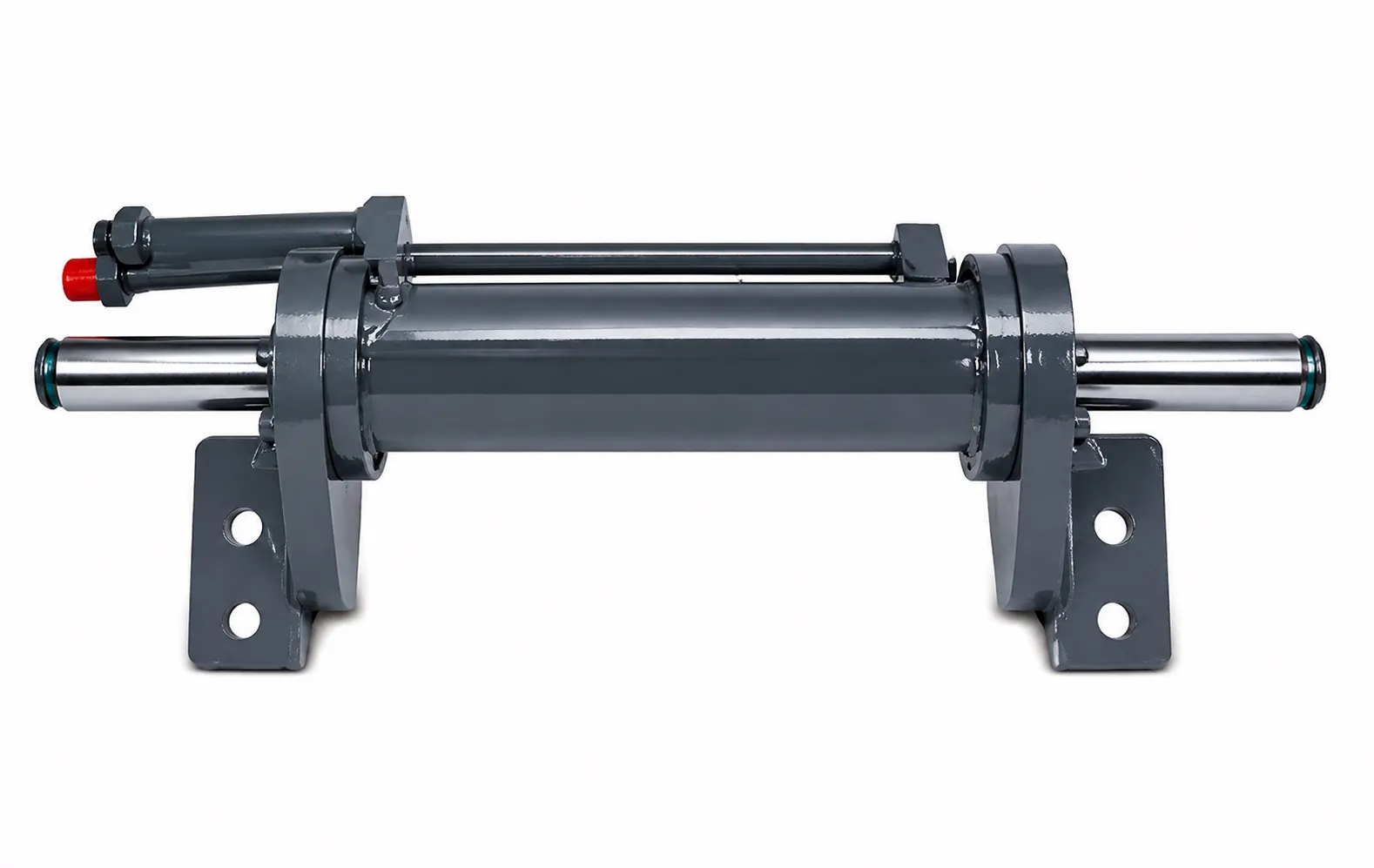
Why These Cylinders Outperform Standard Hydraulic Actuators
Sub-Millimetre Repeatability
Bore tolerances held to H8 and rod diameters to h6 throughout production, giving a fit that eliminates mechanical hysteresis from the steering loop. A GPS-guided tractor working a 12-metre tramline system in the East Midlands depends on this consistency to keep wheel tracks accurate across hundreds of passes per season.
Low Internal Friction
Composite-lined guide rings replace traditional bronze bushings, reducing stick-slip by over 60% compared to older designs. In closed-loop control, lower friction means the controller needs smaller correction pulses, which translates to smoother field steering and reduced valve wear over the machine’s service life.
Integral Sensor Compatibility
End-cap boss machined to accept standard M12 magnetostrictive transducers without adaptor brackets. This native fit eliminates the angular errors that arise when external sensors are bolted on as an afterthought, and ensures the position signal remains clean through the vibration environment of a field-going machine.
IP67-Rated Rod Protection
Double-lip rod wiper seals with integrated labyrinth scraper channel prevent ingress of fine silty soil particles — the kind encountered after autumn ploughing on English clay-based fields — from reaching the primary sealing system. Field trials show this arrangement extends seal service intervals by approximately 40% versus single-wiper configurations.
High Cycle Fatigue Rating
Piston rod and barrel welds subjected to full-penetration TIG welding with post-weld heat treatment, achieving fatigue cycles exceeding 5 million at 80% rated pressure. An autonomous sprayer making 10,000 steering corrections per 10-hour working day accumulates actuation cycles rapidly — the structural rating needs to match the operational reality of modern precision farming.
Cold-Start Performance
With HNBR seals and low-viscosity-compatible guide rings, the cylinder reaches full steering accuracy within two actuation cycles from a -10°C cold start — relevant for early spring planting seasons across northern England and Scotland where ground frosts are common into April.
Product Technical & Performance Parameters
| Parameter | Standard Range | Autonomy-Grade Extended | Unit |
|---|---|---|---|
| Bore Diameter | 40 – 100 | 50 – 160 | mm |
| Rod Diameter | 25 – 70 | 30 – 110 | mm |
| Maximum Working Pressure | 160 – 210 | 200 – 280 | bar |
| Test Pressure | 1.5 × MWP | 1.5 × MWP | — |
| Stroke Length | 50 – 500 | Custom to 2000 | mm |
| Steering Angle (wheel turn) | ±30° | ±45° (custom) | degrees |
| Position Sensor Boss | Optional M12 port | Standard M12 boss | — |
| Operating Temperature | -20 to +80 | -30 to +100 | °C |
| Rod Surface Hardness | 55 – 58 HRC | 58 – 62 HRC | HRC |
| Chrome Plating Thickness | 15 – 25 | 20 – 35 | µm |
| Bore Surface Finish (Ra) | 0.3 – 0.5 | 0.2 – 0.4 | µm |
| Fatigue Cycle Rating | >1,000,000 | >5,000,000 | cycles at 80% MWP |
| Mounting Options | Clevis, Trunnion, Eye | All + custom flange | — |
| Ingress Protection (rod seal) | IP65 | IP67 | — |
Industrial Application Scenarios for Autonomous Agricultural Steering Cylinders
Explore Related Hydraulic Cylinder Products
While steering cylinders form the directional backbone of autonomous ag machines, the same platforms often rely on precision lifting and attachment cylinders for implement control. The following solutions from our product range are engineered to the same manufacturing standards:
Mini Forklift Attachment Hydraulic Cylinder
Compact double-acting cylinder designed for precise implement attachment control on mini forklifts and material handling platforms. Shares the same precision bore finishing and seal specification as our agricultural steering cylinder range, ensuring reliability in continuous industrial duty cycles. Widely used across UK logistics hubs and warehouse operations from Birmingham to Leeds.
Medium-Duty Forklift Attachment Hydraulic Cylinder
Engineered for medium-duty forklift attachment applications requiring higher load capacity and extended service intervals. The cylinder rod is manufactured from the same 42CrMo4 alloy steel used in our agricultural steering cylinder production line, providing consistent fatigue resistance across both product families. Suitable for cold storage, agricultural distribution centres, and manufacturing facilities across Sheffield, Coventry, and the wider West Midlands.
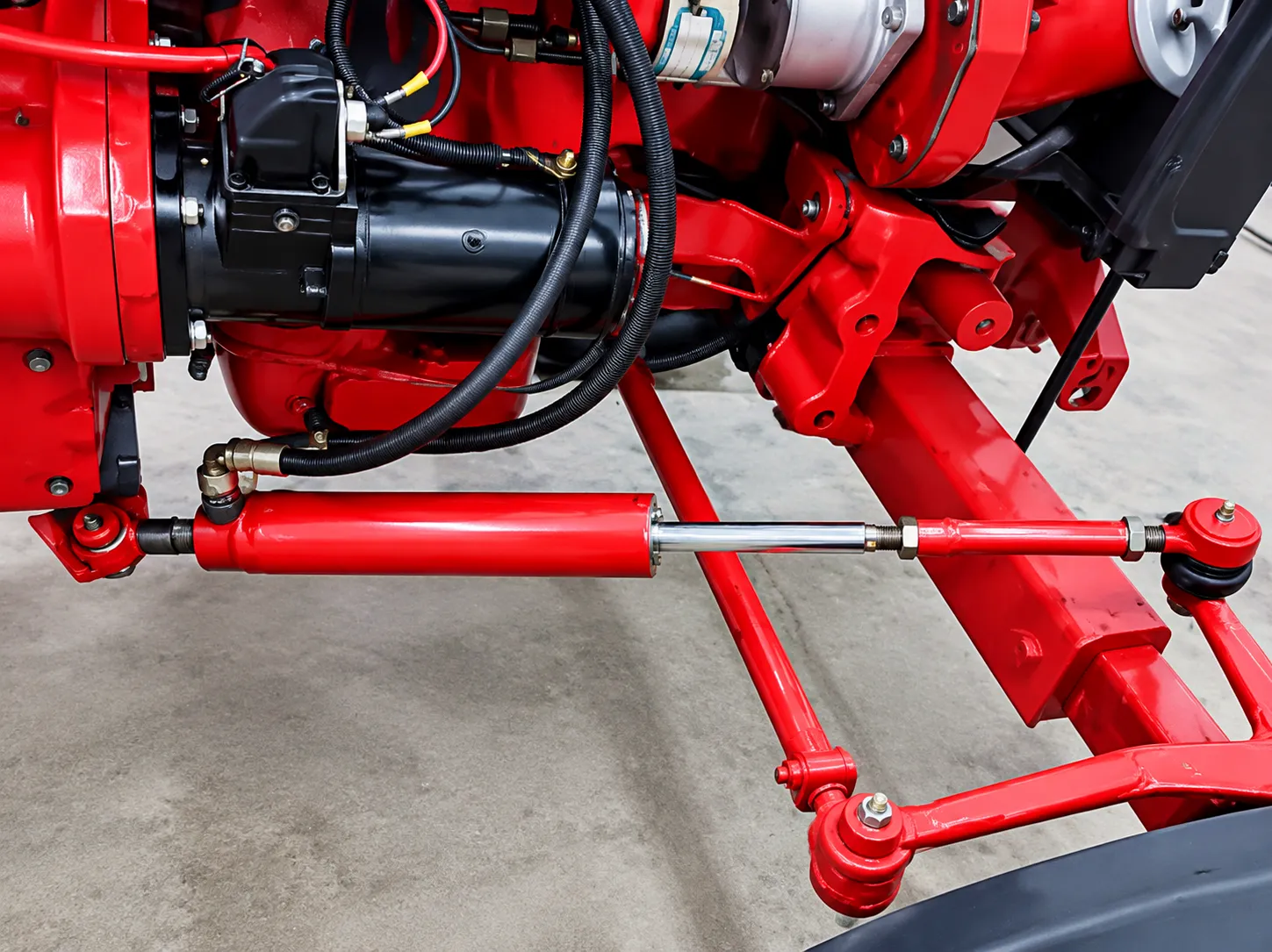
Ever Power — Manufacturing Capability & Custom Engineering
Ever Power operates a dedicated hydraulic cylinder manufacturing facility equipped with CNC honing lines capable of achieving Ra 0.2 µm on bores up to 200 mm diameter. The factory runs a closed-loop quality management system with 100% dimensional inspection of piston rods, CMM verification of machined end caps, and hydrostatic pressure testing of every cylinder at 1.5 times the rated working pressure before despatch. For autonomous agricultural equipment integrators — whether they are retrofitting guidance systems to existing machine fleets or designing new autonomous platforms from the ground up — Ever Power’s engineering team provides full cylinder specification support, from calculating optimal bore/rod ratio for a given load case, through to selecting the correct seal compound for the hydraulic fluid in use on the specific machine platform.
Customisation capabilities at Ever Power extend to non-standard port configurations to suit specific valve block interfaces, custom clevis and trunnion mounting profiles to fit OEM chassis geometry, corrosion-resistant external coatings including electrophoretic primer plus polyurethane topcoat for wet UK operating conditions, and factory-fitted sensor bosses machined and tapped to customer-specified thread forms. Lead times for standard configurations from stock start at 3–5 working days for UK agricultural machinery dealers, while custom engineered units follow a 4–6 week manufacturing lead time from drawing approval.
The supply chain backing Ever Power’s production includes verified steel billet suppliers certified to EN 10083, seal manufacturers operating to the DIN ISO 6195 standard, and chrome plating subcontractors holding third-party NADCAP approval. Every batch of incoming rod material is spectrographically analysed before entering the production line — a step that prevents the material substitution failures that have caused field cylinder failures on competitor products.
Manufacturing Highlights
✔ CNC honing Ra 0.2 µm standard
✔ 100% hydrostatic test at 1.5 × MWP
✔ CMM inspection every batch
✔ EN 10083 steel certification
✔ NADCAP-approved chrome plating
Customer Success: Lincolnshire Precision Arable Operation
Case Study — Autonomous Tractor Fleet Upgrade, South Lincolnshire
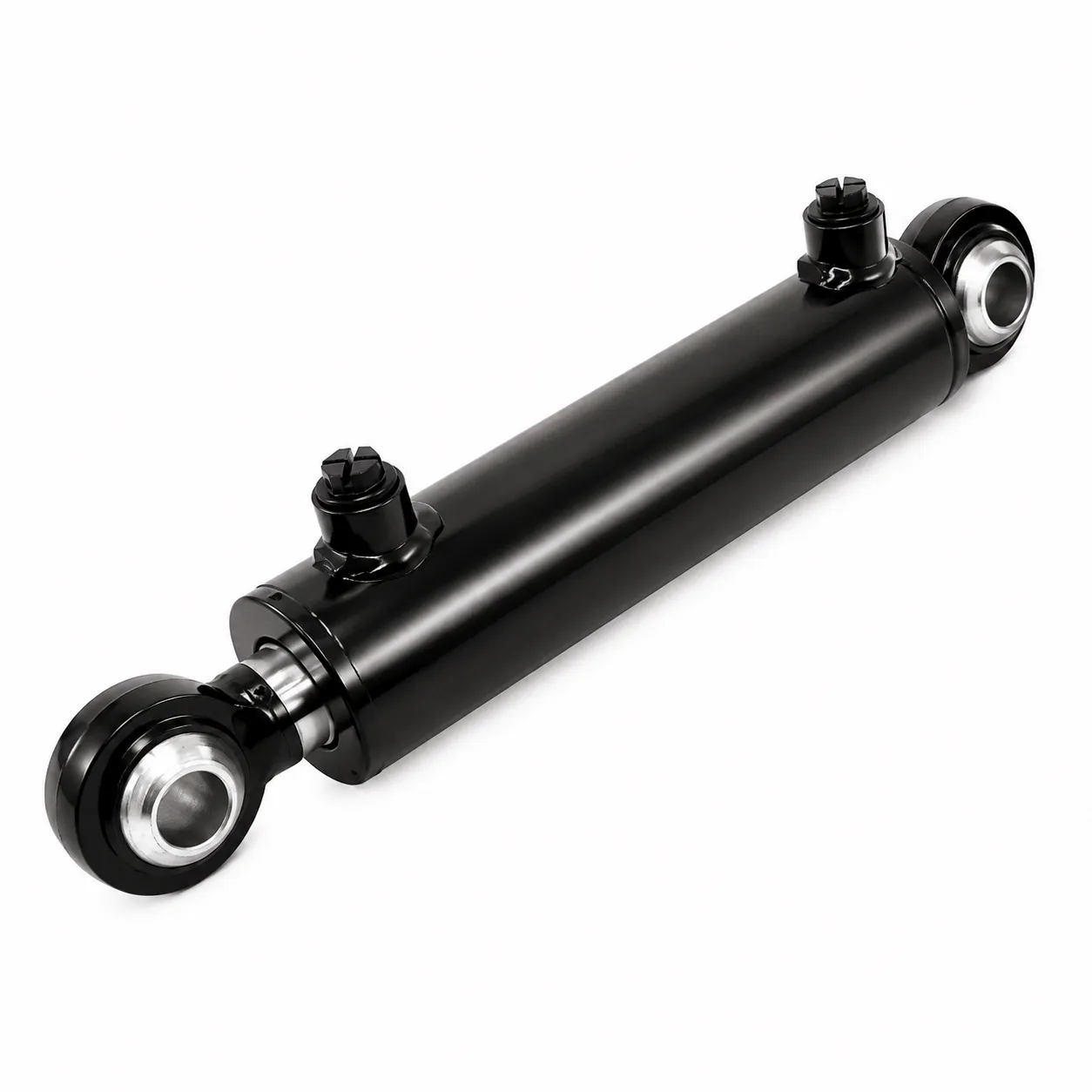 A family-owned arable enterprise operating 620 hectares of fenland between Spalding and Boston began a phased autonomous guidance programme in spring 2024, converting four John Deere 6R series tractors to full RTK autosteer operation for cultivation, drilling, and spraying passes. The initial conversion used aftermarket steering cylinders from a European supplier, but field reports after the first season identified a recurring problem: path deviation of up to 8 centimetres was occurring at headland turns when the soil was soft, even though the GPS system was delivering corrections of sub-centimetre accuracy. Engineering investigation identified the root cause as internal mechanical play in the cylinder pivot bearings, which introduced angular error into the control loop that the guidance software could not compensate for without destabilising the steering oscillation.
The farm’s machinery manager contacted Ever Power after seeing a technical discussion on a UK precision farming forum. Ever Power’s engineers conducted a remote load analysis based on the tractor chassis spec and operating parameters, and proposed a replacement cylinder with 80 mm bore, 50 mm rod, integrated M12 transducer boss, and H7/h6 bore-to-rod tolerance class throughout. Units were manufactured and delivered to a local agricultural machinery dealer in Boston within 14 working days. After installation and re-calibration of the autosteer system, field trials showed consistent path accuracy of 1.8 centimetres RMS across all soil conditions — within the performance specification of the GPS guidance system itself. The farm estimated the accuracy improvement translated to a reduction in seed and fertiliser overlap that would recover the cylinder investment cost within a single drilling season.
The experience led the same enterprise to specify Ever Power steering cylinders for a subsequent purchase of a 36-metre self-propelled autonomous sprayer, where the same engineering rigour was applied to a larger bore requirement and a trunnion-mount configuration. Two seasons of operation on that machine have produced no seal failures or dimensional drift — a record the previous supplier was unable to match on identical operating hours.
What UK Customers Say
★★★★★
“We had three seasons of chasing path errors on our autonomy conversion before Ever Power cylinders went in. The difference in steering loop stability was immediately obvious during our first field calibration run — the guidance processor settled to its target line within two corrections instead of oscillating for six or seven. For anyone running RTK autosteer on heavy clay, the bore tolerance spec on these cylinders genuinely matters.”
J. Whitfield — Arable Farm Manager, South Lincolnshire
★★★★★
“The custom clevis and trunnion profiles Ever Power produced for our autonomous sprayer retrofit saved us at least three weeks of fabrication time on the chassis. The cylinders arrived with full material certificates, pressure test reports, and dimensional inspection data — exactly what we needed for our own CE documentation package. The technical support team understood our valve block interface from the first email exchange.”
R. Atkinson — Technical Director, Agricultural Machinery Integrator, Yorkshire
★★★★★
“We operate robotic harvest platforms in Kent soft-fruit production, and the short-stroke cylinders from Ever Power have survived two full seasons of near-continuous operation without any seal replacements. The IP67 rod protection was the specification point we insisted on, given the wet, soil-laden conditions on our rows in October. Delivery to our dealer in Maidstone was faster than quoted.”
S. Blyth — Operations Manager, Robotic Horticulture Enterprise, Kent
Frequently Asked Questions
How much does a custom steering cylinder for autonomous agricultural equipment typically cost from a UK-sourced supplier?
Pricing varies significantly depending on bore size, stroke length, sensor integration, and the level of customisation required. A standard autonomy-grade steering cylinder in the 70–90 mm bore range with an M12 transducer boss will typically carry a unit cost between £180 and £450 from a quality manufacturer when ordered in small batches of 5–10 units. Custom profiles, special coatings, and NADCAP-certified chrome plating add to this baseline. Contact Ever Power at [email protected] for a project-specific quote — most standard specifications can be priced within 24 hours of receiving your dimensional requirements and operating pressure data.
What is the best type of steering cylinder to use for a GPS autosteer retrofit on a John Deere 6R series tractor operating in wet UK field conditions?
For a JD 6R autosteer retrofit in UK conditions, you want a double-acting cylinder in the 70–80 mm bore range with a 50 mm hardened chrome-plated rod, H7/h6 bore-rod tolerance class, IP67-rated rod wiper seals, and a native M12 sensor boss on the gland end cap. The critical specification is bore tolerance — the 6R autosteer controller is sensitive to mechanical hysteresis, and a cylinder with internal play above 0.15 mm will cause the guidance system to oscillate rather than settle on the target line. Specify HNBR piston seals rather than standard NBR if the tractor uses a biodegradable hydraulic fluid, which is increasingly common on UK farms with environmental scheme requirements.
Which hydraulic steering cylinder supplier in the UK can provide ISO-certified cylinders with full material traceability for agricultural autonomous vehicle projects?
Ever Power supplies autonomy-grade steering cylinders with EN 10083 steel certification, full material heat traceability, CMM inspection reports, and hydrostatic test records as standard documentation for every batch. For CE marking purposes on autonomous agricultural machinery, this documentation package covers the hydraulic cylinder as a pressure-bearing component under the Pressure Equipment Directive. Enquiries from OEM integrators and machinery dealers across Birmingham, Sheffield, Norwich, and other UK agricultural machinery centres are handled through [email protected] with a typical documentation response time of 2–3 working days.
How do I calculate the correct bore size for a steering cylinder on an autonomous combine harvester operating in the Scottish Lowlands at high load?
The bore size calculation starts from the maximum lateral force at the steering knuckle, which is determined by machine mass, tyre contact patch geometry, and the maximum slope angle on which the machine must hold a straight line. For a 25–35 tonne loaded combine, typical lateral steering forces range from 8 to 22 kN at the cylinder. Dividing the required force by the system operating pressure (in MPa) gives you the minimum effective piston area: A = F / P. Apply a 20–25% safety margin, then select the nearest standard bore size from above that area. An ever Power engineer can perform this calculation for your specific machine at no charge — contact us with the chassis spec sheet and we will return a bore, rod, and pressure recommendation within 48 hours.
Where can I find a reliable UK-based distributor who stocks precision hydraulic steering cylinders for autonomous sprayer applications in Yorkshire and Humberside?
Ever Power works with a network of agricultural machinery dealers and hydraulic component distributors across the UK, including those serving the Yorkshire, Humberside, and North Lincolnshire markets. Standard autonomy-grade steering cylinder configurations can typically be supplied through a local dealer partner within 5–7 working days. Custom specifications ship direct from our manufacturing facility. Contact [email protected] with your location and cylinder requirement, and we will identify the most efficient supply route for your project — whether that is dealer stock, direct shipment, or a consignment arrangement for fleet-scale projects.
When should I replace the steering cylinder on my semi-autonomous tractor, and what are the signs of hydraulic cylinder wear that affect autosteer accuracy?
The clearest indicator of a steering cylinder causing autosteer degradation is increased path deviation that cannot be resolved by recalibrating the guidance system or replacing the GPS antenna. Specifically, a cylinder reaching the end of its service life typically shows up as oscillatory steering behaviour — the guidance controller increases correction, overcorrects, and the machine weaves rather than tracking straight. Other diagnostic signs include external oil weeping at the rod seal (visible on the chrome rod surface), increased break-out force measured by the machine’s hydraulic diagnostic tool, and physical play detectable by grasping the rod with the system depressurised. As a general service interval, autonomy-grade cylinders operating in intensive arable applications should be dimensionally inspected at 1,500 engine hours and replaced proactively at 3,000 hours or at the first sign of internal play exceeding 0.1 mm.
Ready to Specify the Right Cylinder?
Talk to Ever Power’s Engineering Team
From bore selection to custom sensor integration, we handle every detail. UK-serving agricultural machinery OEMs and integrators welcome.
[email protected] · Ever Power Industrial
edit by gzl