
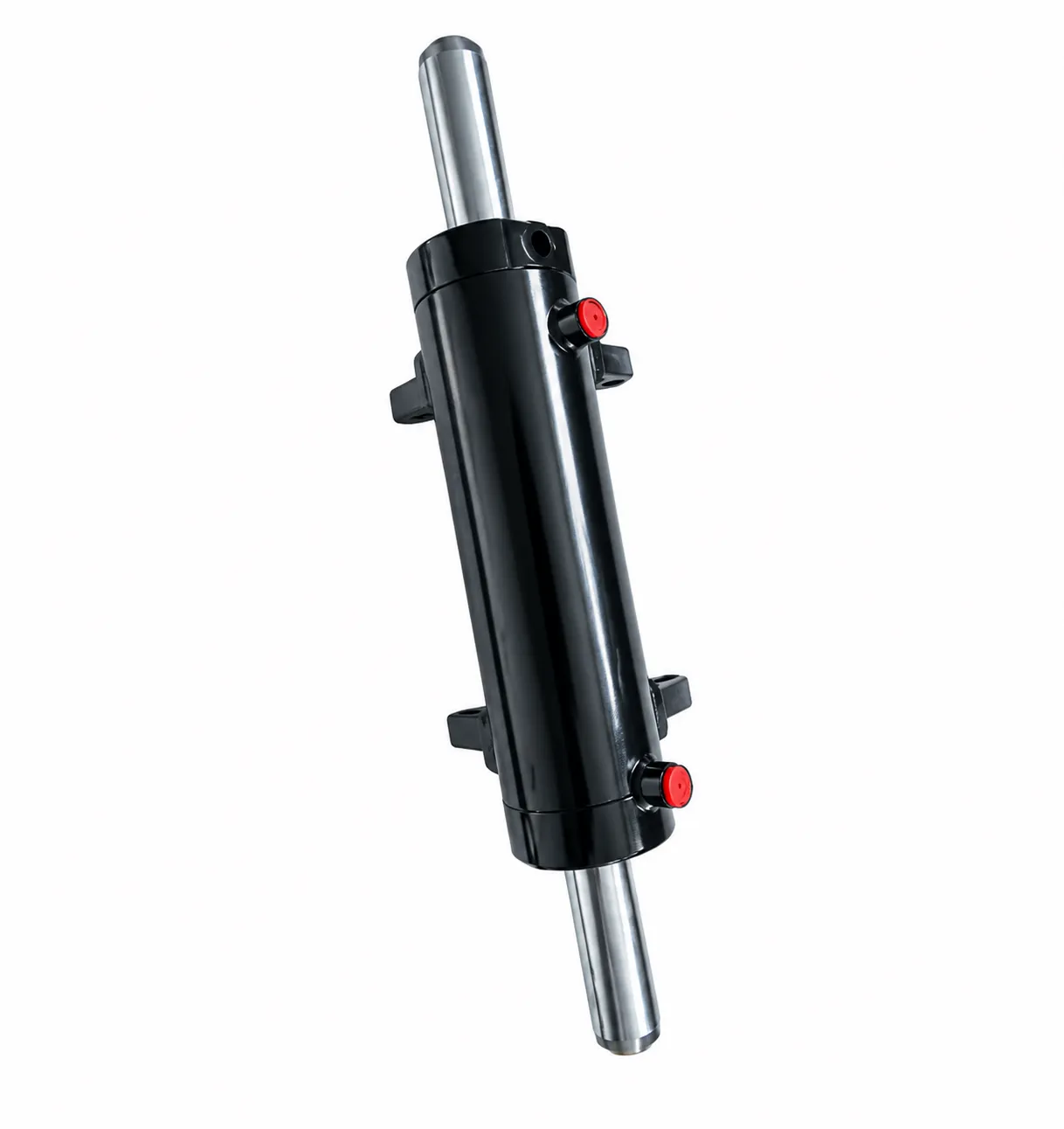
How the Road Grader Steering Cylinder Actually Works
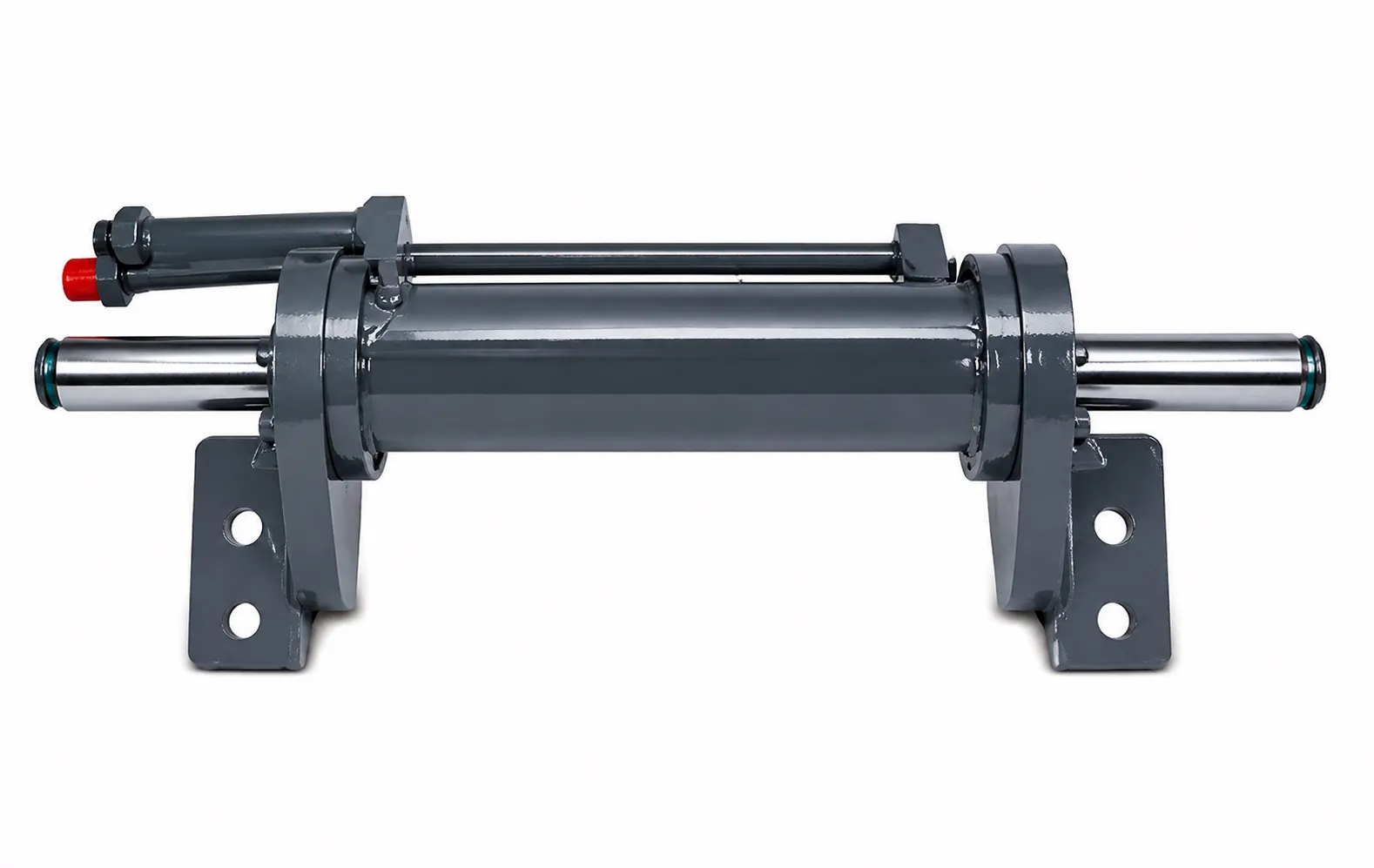
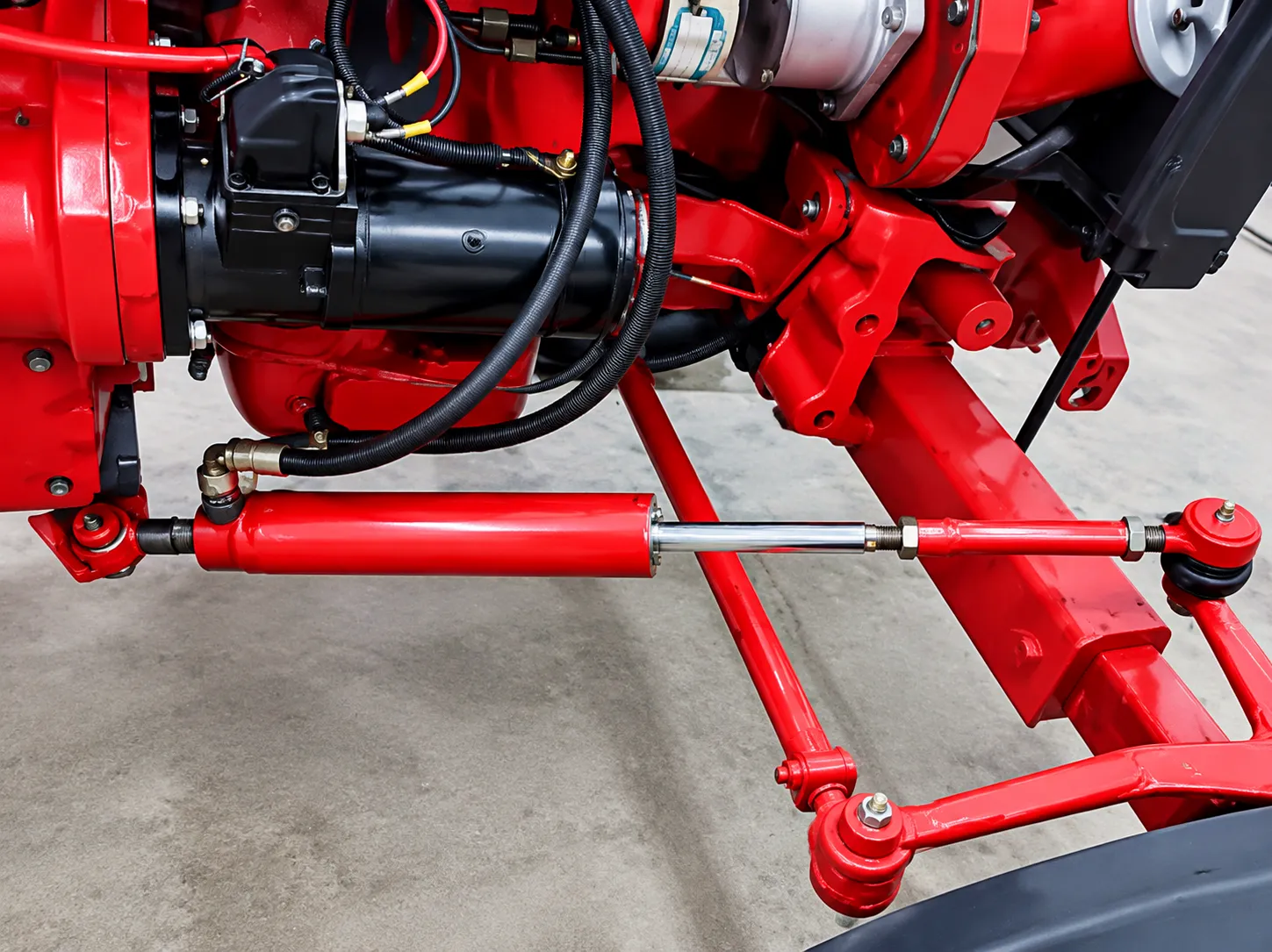
The steering cylinder on a motor grader operates as a double-acting hydraulic actuator, positioned between the front axle beam and the wheel spindle knuckle. Pressurised hydraulic fluid — typically at working pressures between 200 and 280 bar — is directed alternately to either side of the piston face. The pressure differential generates a linear force along the cylinder axis, which is converted by the steering linkage geometry into rotational movement of the front wheels. On a typical grader, two cylinders work in a push-pull arrangement to maintain positive steering authority even when one side is at the end of its stroke. The relationship between cylinder bore diameter, operating pressure, and the mechanical advantage of the steering linkage arm determines how much steering force is available at the wheel rim — a figure that must comfortably exceed the maximum lateral soil reaction force encountered during blade work in heavy ground conditions such as clay-rich sub-base or frost-heaved aggregate.
Lateral load management is achieved through the integration of a hard-chrome-plated piston rod, precision-honed barrel bore, and a multi-lip seal system specifically rated for side-load conditions. When the front wheels encounter camber, ruts, or crossfall — as they routinely do during road reshaping work on rural B-roads across England’s North — the force vector applied to the rod shifts away from pure axial alignment. The cylinder must resist this bending moment through the combination of its wall thickness, rod diameter ratio, and the radial support provided by the rod-end bushing. A correctly designed grader steering cylinder distributes this transverse stress across a broad bearing length, preventing localised wear of the barrel bore and protecting the rod seals from being loaded on one side more than the other — a condition that accelerates seal extrusion failure in improperly engineered units.
The end-of-stroke cushioning system represents another critical design element. When a grader operator makes a full lock turn at job site speed, the piston decelerates from full travel velocity to zero in a very short distance. Without internal cushioning — a tapered spear valve that progressively restricts return flow as the piston approaches the end cap — this deceleration causes a pressure spike that can exceed 1.5 times the working pressure. Over thousands of cycles, those pressure spikes fatigue the end cap welds, damage port threads, and distort the cylinder mounting eyes. Well-engineered steering cylinders use adjustable needle-valve cushioning on both ends, allowing field technicians to tune the deceleration rate to match the specific grader model’s mass and hydraulic flow rate.
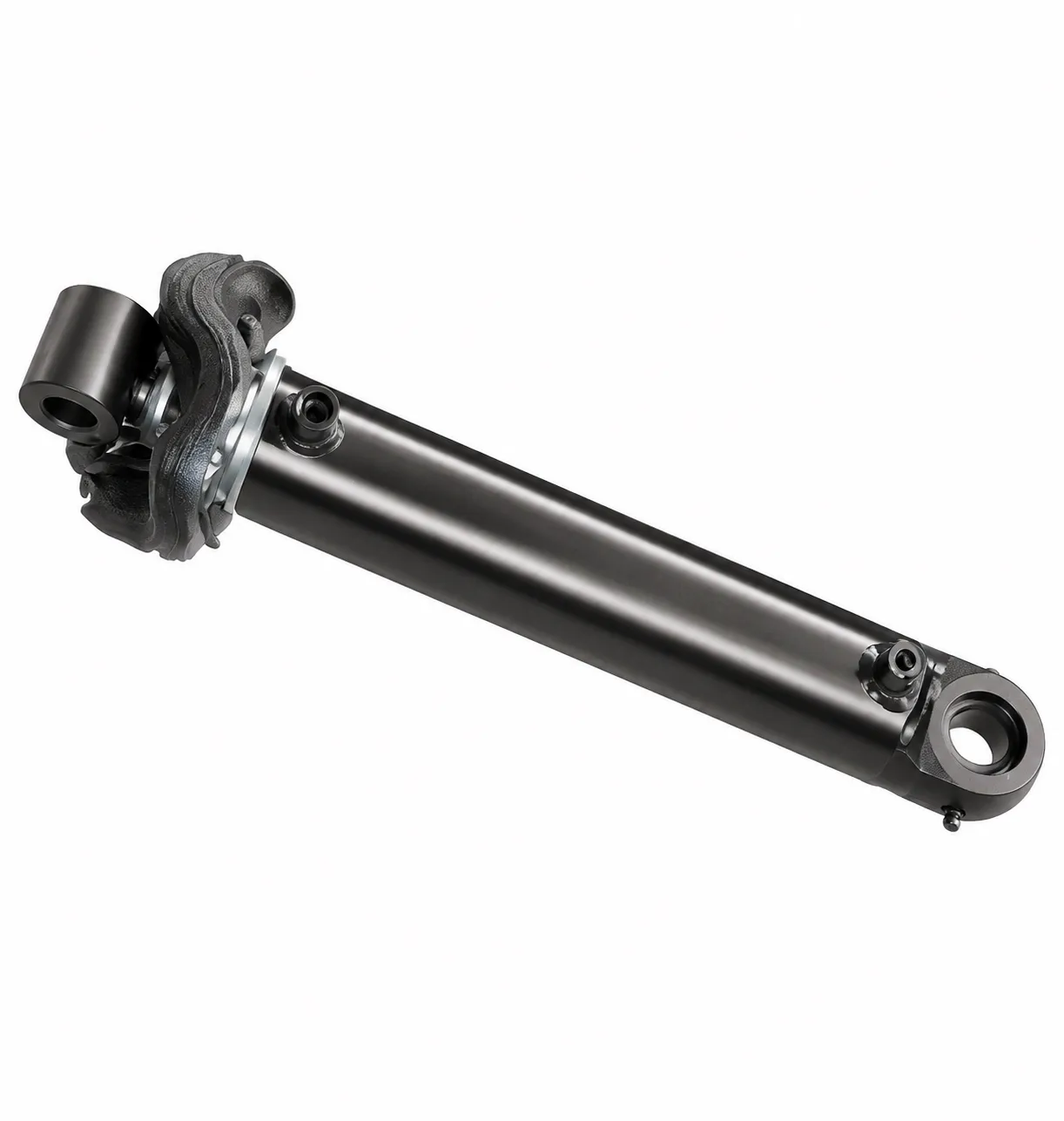
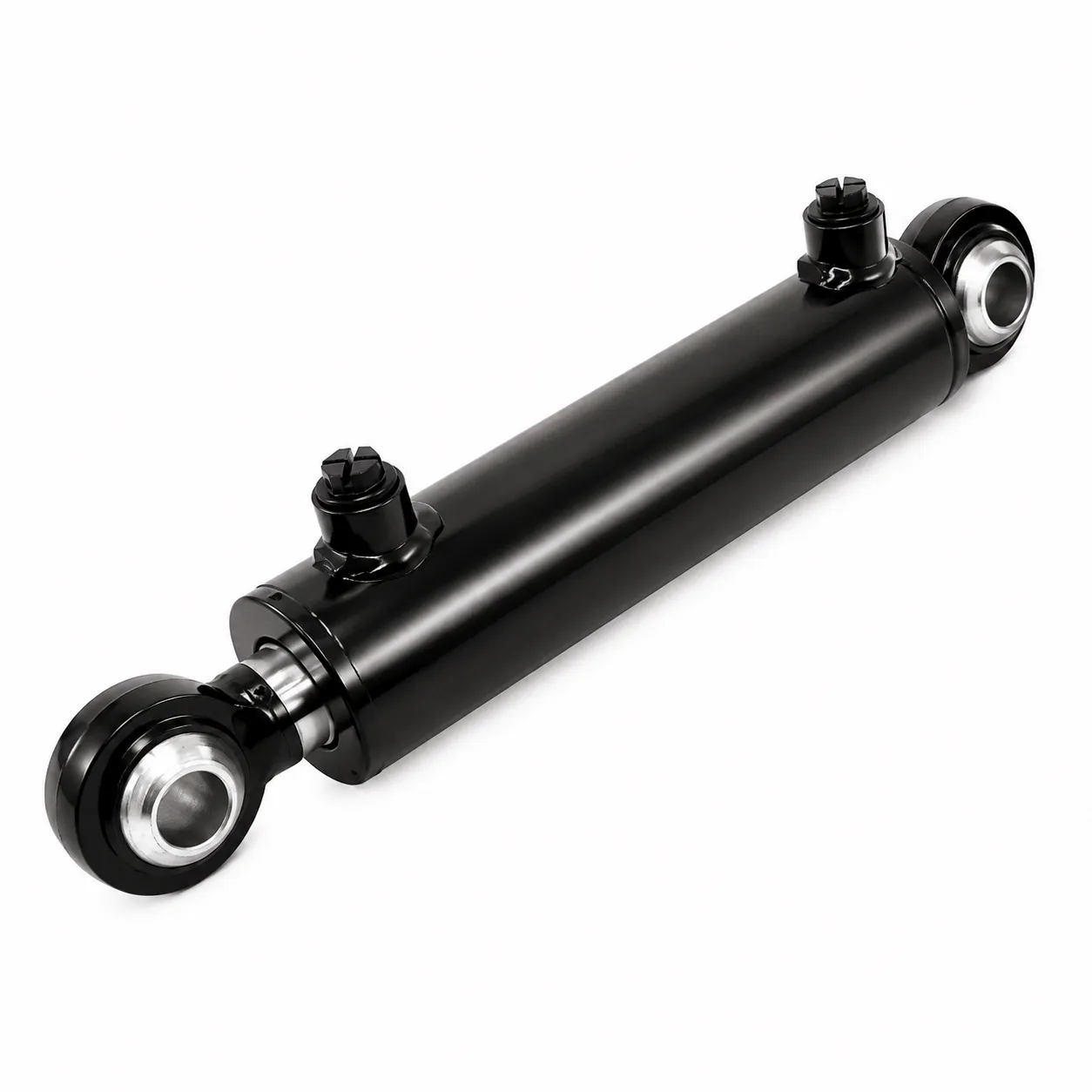
Material Selection: Why Chemistry Matters in Lateral Load Cylinders
Barrel Tube
Cold-Drawn Seamless St52 / E355 Steel
Cold-drawn seamless tubing in St52 (EN 10305-1 E355) grade delivers a guaranteed minimum yield strength of 355 MPa and tensile strength of 500 MPa. The seamless manufacture eliminates the longitudinal weld seam — the natural stress concentration point — allowing the barrel to carry internal pressure and external bending loads simultaneously without the anisotropic weakness a weld introduces. Internal bore surfaces are precision-honed to Ra 0.2–0.4 µm, matching the demands of polyurethane and NBR sealing systems.
Piston Rod
42CrMo4 Hard-Chrome Plated
42CrMo4 alloy steel — quenched and tempered to 850–1,000 MPa yield — provides the bending stiffness essential in side-loaded conditions. An induction-hardened surface layer beneath the chrome plating raises surface hardness to 54–60 HRC, resisting denting from grit contamination that enters through damaged wiper seals during extended field campaigns. Hard chrome thickness is controlled at 20–30 µm and finished to Ra 0.1–0.2 µm for optimal seal longevity.
Seal System
Polyurethane + PTFE Multi-Lip
Grader steering cylinders face temperature swings from below freezing in winter to above 80°C during prolonged high-pressure steering cycles in summer. The seal set — comprising a main polyurethane U-cup, an anti-extrusion PTFE backup ring, a bronze-filled PTFE wear ring, and a polyurethane wiper — is selected to handle this range without compression set. Fluorocarbon (FKM/Viton) seals are offered for applications where biodegradable hydraulic fluids are mandated by UK environmental regulations on sensitive sites.
End Caps & Mounts
Forged Carbon Steel / Ductile Iron
End caps on lateral-load cylinders must resist combined pressure thrust and bending moment simultaneously. Forged carbon steel caps (SAE 1045) are standard; ductile iron (GGG-60) is used where complex internal port geometry or cushion valve housings require casting. All cap-to-barrel joints use multi-pass TIG or submerged-arc welding with preheat and post-weld heat treatment per EN 1011-2, ensuring a Heat Affected Zone that does not compromise barrel strength or distort the bore concentricity to which seals must conform.
Core Technical Advantages of a Properly Engineered Road Grader Steering Cylinder
🎯
High Radial Load Tolerance
The steering cylinder’s bore-to-rod diameter ratio — typically 1.6:1 to 2:1 for grader applications — is calculated using Euler’s column formula extended to include combined axial-plus-lateral loading. A larger rod diameter increases the second moment of area, directly reducing the deflection under side loads. This is why correctly specified grader steering cylinders can sustain radial loads exceeding 8–12 kN at full extension without rod-to-bore contact that would score the barrel surface and destroy the seal.
🔥
Thermal & Pressure Shock Resistance
A double-acting steering cylinder in grader service sees system-pressure shock pulses each time the hydraulic relief valve opens against a locked steering input. Cylinder designs incorporating forged end caps, full-penetration welds, and thread-locking port inserts demonstrate burst pressure ratings typically 4× working pressure — well above the 2.5× minimum required by ISO 6020-2. This safety margin matters when remote-site UK operations mean that the nearest service centre may be 50 miles away and extended machine downtime carries significant contractual penalties.
⚙
Precision Dimensional Stability
Bore honing achieves cylindricity within 0.015 mm along the full barrel length. This geometric accuracy ensures that the seal and wear ring maintain consistent radial compression across their full circumference, preventing the localised high-pressure zones that cause premature seal extrusion. Rod straightness is held to within 0.05 mm per metre, a tolerance level only achievable through centreless grinding rather than lathe turning alone. Combined, these accuracies allow the cylinder to maintain oil-tight performance across the designed operating life cycle.
🕷
Corrosion Resilience for UK Field Conditions
British weather presents a particular challenge for hydraulic cylinders working outdoors year-round. Road salting programmes across England and Scotland mean that exposed steel surfaces face chloride attack far beyond what tropical markets experience. Grader steering cylinders intended for UK deployments require a hard chrome rod with no micro-cracks in the deposit layer (verified by acid etch test), a barrel exterior coated with two-part epoxy primer plus polyurethane topcoat rated for 2,000 hours salt spray per ISO 9227, and stainless steel or zinc-passivated port adaptors that resist white rust in standing water conditions.
Technical & Performance Parameter Reference Table
| Parameter | Standard Range | Custom / Extended Option | Notes / Standards |
|---|---|---|---|
| Bore Diameter | 63 mm — 140 mm | Up to 200 mm | ISO 6020-2 preferred bore series |
| Rod Diameter | 40 mm — 100 mm | Up to 140 mm | Rod/bore ratio min. 0.56 for side-load service |
| Working Pressure | 200 — 280 bar | Up to 320 bar | Burst test 4× working pressure |
| Stroke Length | 150 mm — 500 mm | Up to 800 mm | Slenderness ratio checked to Euler limits |
| Operating Temp. Range | -30°C to +80°C | -40°C to +100°C (FKM seals) | Standard seals: NBR + PU |
| Bore Surface Finish | Ra 0.2 — 0.4 µm | Ra 0.1 µm (ultra-precision) | Diamond-honed, 30° crosshatch |
| Rod Surface Hardness | 54 — 60 HRC | 60+ HRC (ceramic chrome) | Induction hardened + hard chrome |
| Mounting Options | Clevis / Trunnion / Flange | Side lug, foot-mounted, pivot pin | Custom OEM bracket design available |
| Corrosion Protection (Rod) | Hard chrome 20–30 µm | Ceramic chrome / HVOF coating | Acid etch crack test to EN ISO 6158 |
| Salt Spray Rating (Barrel) | 1,000 hr (standard coating) | 2,000 hr (2-pack PU topcoat) | ISO 9227 NSS test |
| Lateral Load Rating (radial) | Up to 12 kN at full stroke | Up to 20 kN (reinforced rod) | Verified by FEA deflection modelling |
| End Cushioning | Fixed both ends | Adjustable needle valve, both ends | Field-adjustable deceleration rate |
Industrial Application Scenarios: Where Road Grader Steering Cylinders Are Deployed
🛣
Highway Pavement Maintenance — England & Wales
National Highways and regional council road teams deploy motor graders for carriageway resurfacing preparation, shoulder re-grading, and drainage channel maintenance across England and Wales. Graders on A-road maintenance contracts near Birmingham and the M1 corridor operate on cambered, rutted surfaces where steering input is near-constant and the cylinder is rarely in a centred, low-load position. The steering cylinder on machines used in these environments must tolerate millions of small steering corrections throughout a 10-hour work shift, demanding exceptional fatigue life in the barrel weld heat-affected zone and the piston rod thread runout.
🌎
Opencast Mining Access Roads — Scotland & Wales Coalfields
Opencast extraction sites in South Wales and Ayrshire require continuous haul road maintenance to prevent excessive tyre wear on heavy dump trucks. Graders working on haul roads experience the highest lateral load cycles in the entire grader application range. Road geometry constantly changes as the working face advances, meaning the grader operates on steep cross-gradients with the blade in cut position at almost all times. The steering cylinder in these conditions carries both the steering force and a significant portion of the side force generated by the front axle fighting camber-induced self-steer. Extended replacement intervals demanded by remote site logistics make seal longevity the single most commercially important design criterion.
🏙
Construction Site Subgrade Preparation — Major Infrastructure Projects
Infrastructure projects — from logistics park groundworks in the East Midlands to wind farm access road construction in Northern Scotland — rely on motor graders for precision subgrade trimming to within ±10 mm of design level. This demands slow travel speed with high blade downforce, concentrating all the lateral soil reaction force at the blade tip and transmitting it through the front axle geometry into the steering cylinder. At low speeds, hydraulic pressure to overcome ground resistance is highest. Steering cylinders in this application need minimum internal leakage to hold the front wheels absolutely fixed without continuous pump flow — a requirement that drives extremely tight piston seal compression tolerances.
✈
Airfield Pavement Maintenance — UK Civil and MOD Airports
Civil airports operated under CAA oversight and Ministry of Defence airfields use graders for FOD (Foreign Object Debris) clearance, rubber deposit removal preparation, and taxiway edge maintenance. Airfield specifications require zero fluid leakage onto pavement surfaces — a single drip of hydraulic oil can ground aircraft and trigger regulatory reports. Steering cylinders on airfield graders are specified with face-seal (O-ring face seal / ORFS) hydraulic ports rather than parallel or NPT threads, combined with secondary containment wiper systems that capture any rod leakage before it can fall to the pavement. The cylinder must meet zero-leakage performance verified by a 15-minute static pressure hold test before dispatch.
🔗 Related Product Solutions for Material Handling Lateral Load Applications
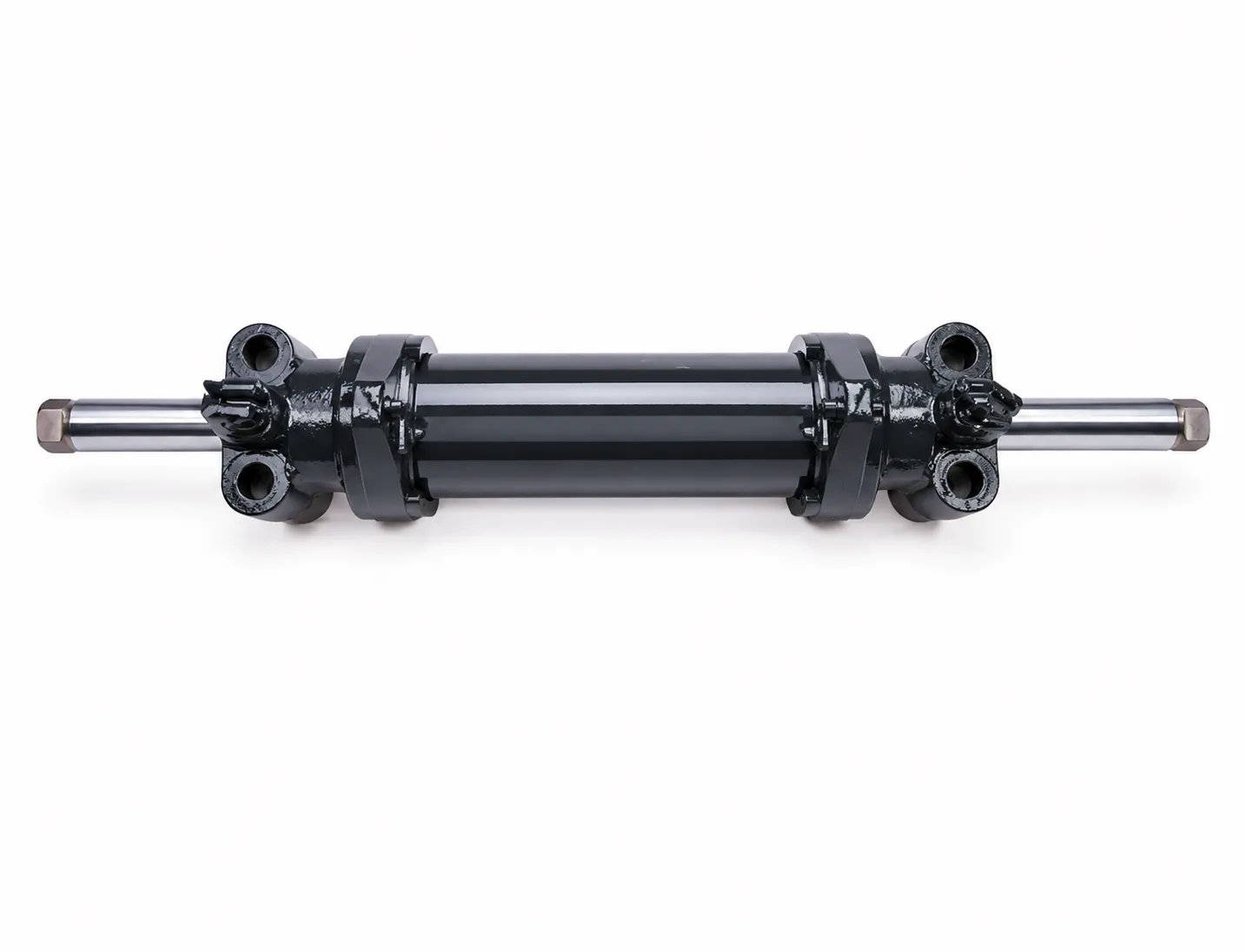
Manufacturing Partner
Ever Power: Custom Steering Cylinder Manufacturing for Global OEM & Aftermarket
Ever Power operates dedicated hydraulic cylinder production lines with a specific capability cluster built around custom engineering for demanding mobile machinery applications. The manufacturing facility combines CNC deep-hole boring machines, multi-pass honing centres, crankshaft-type OD grinding for precision rods, robotic MIG and TIG welding cells, and fully enclosed paint systems within a quality management structure certified to ISO 9001:2015. For UK-market grader steering cylinder programmes — whether original equipment supply for a machinery manufacturer or aftermarket fit-to-type production for a fleet operator based in Sheffield or Leeds — Ever Power can deliver fully validated cylinder assemblies from a customer’s engineering drawings, or develop a drawing package from dimensional data taken from a physical sample.
🏗
Customisation Capability
Non-standard bore series, asymmetric stroke cushioning, dual-rod configurations, integrated position sensor housings, special port orientation, and grader-specific clevis eyes with hardened bronze bushings — all engineered to customer specification with full first-article inspection reports.
📊
Quality Assurance & Testing
Every steering cylinder dispatched undergoes a 100% hydraulic pressure test at 1.5× working pressure, an internal leakage test at working pressure, a stroke function test with recorded force output, and surface finish verification by contact profilometry. Test records are retained and supplied with each unit.
✈
Supply Chain & UK Logistics
Ever Power ships to UK construction equipment distributors, OEM assembly plants, and fleet service centres via established freight lanes to Felixstowe, Southampton, and Tilbury, with standard lead times of 4–8 weeks for custom builds and express production options for urgent replacements on machines with extended downtime cost implications.
Frequently Asked Questions about Road Grader Steering Cylinders
Ready to Specify Your Road Grader Steering Cylinder?
Ever Power’s engineering team is ready to review your application, calculate your lateral load requirements, and deliver a fully tested, UK-specification cylinder to your fleet location.
[email protected] · Ever Power Industrial Hydraulics
edit by gzl