
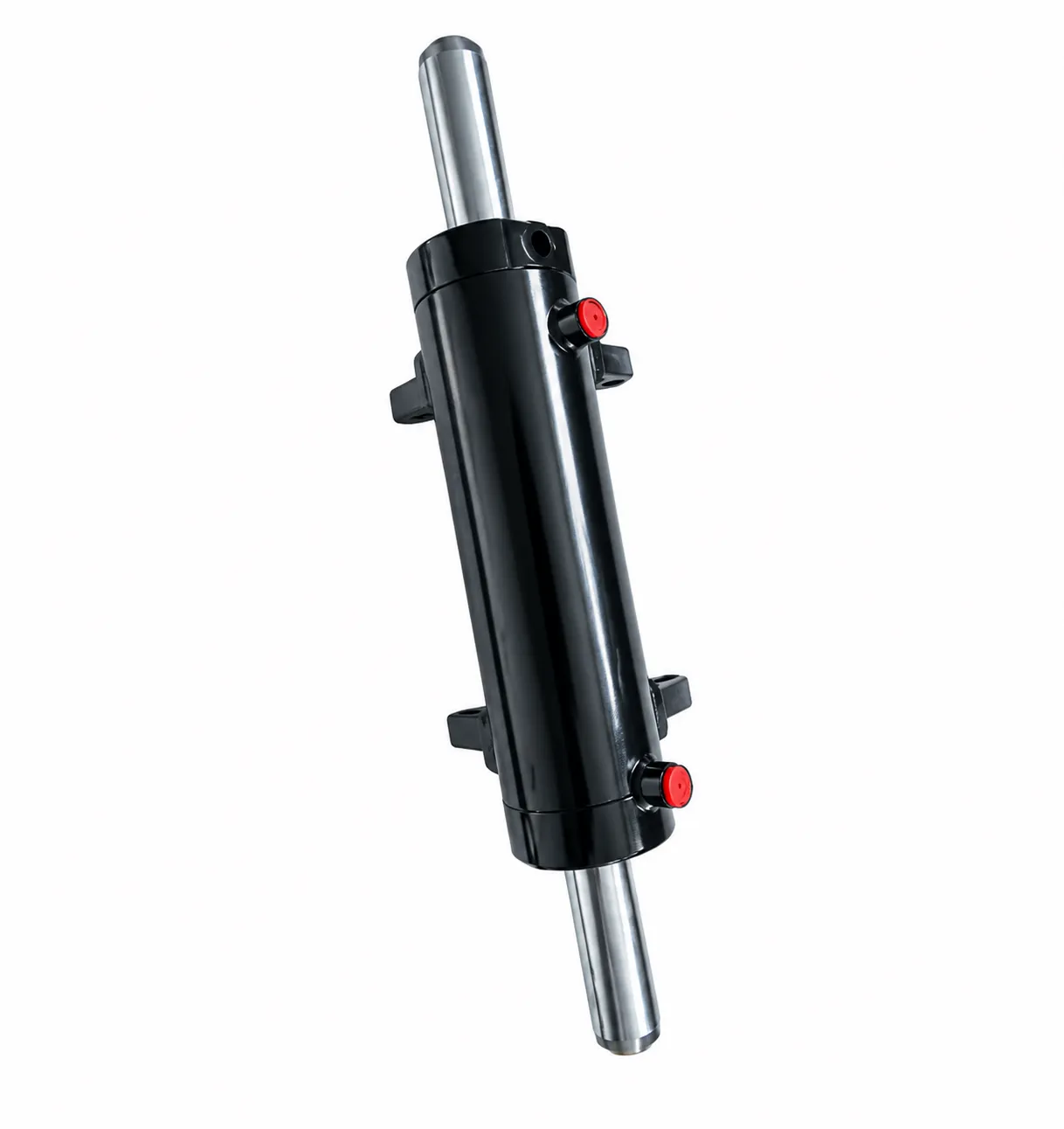
The Working Principle Behind Excavator Steering Cylinders
Pressurised hydraulic fluid — typically operating in the range of 210 to 350 bar on full-size excavators — enters the cylinder via a directional control valve. The valve responds to pilot pressure signals originating from the operator’s joystick or foot pedals, routing oil to either the cap-end or the rod-end of the cylinder bore. This differential pressure acts on the piston, generating a push or pull force that extends or retracts the piston rod.
The linear force produced by the piston rod is transmitted through a clevis or pivot-mount arrangement to the steering linkage — in a crawler excavator, this typically connects to the idler tension mechanism or track-frame pivot arm. In a wheeled excavator, the cylinder connects directly to the steering knuckle or articulation joint. The mechanical advantage built into the linkage geometry multiplies the cylinder’s force output, allowing a relatively compact actuator to redirect multiple tonnes of machine mass.
Advanced excavator platforms — increasingly common in UK plant fleets upgrading to ISO-compliant precision-control systems — integrate position transducers directly into the steering cylinder body. These sensors feed real-time stroke data back to the machine’s ECU, enabling closed-loop position control. The result is repeatable steering angles that can be digitally limited, logged, and adjusted without mechanical re-shimming. This has profound implications for automated and semi-autonomous excavation tasks now being trialled on UK infrastructure projects.
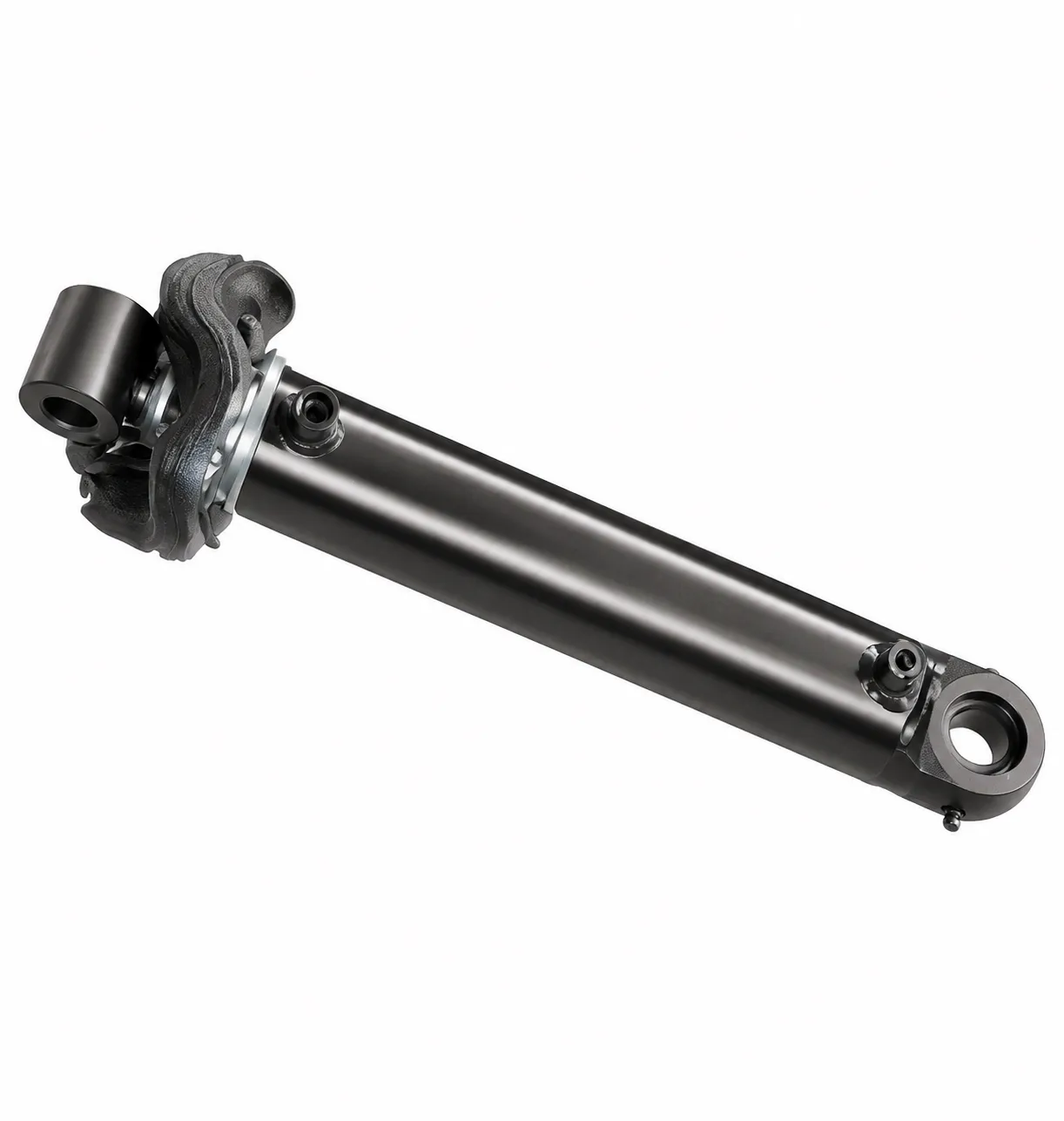
Core Materials in Precision Steering Cylinder Manufacturing
The performance envelope of a steering cylinder is set, in large part, by the materials from which it is built. Excavators operating in UK conditions — which include cold winter starts, variable ground conditions from soft alluvial soils in East Anglia to hard rock in the Welsh Valleys, and the relentless vibration of demolition work in urban centres — demand materials chosen for durability, sealing compatibility, and fatigue resistance, not merely static load capacity.
Cold-drawn precision seamless steel tube with a minimum tensile strength of 580 MPa. The inner bore is honed to Ra 0.4 µm or finer to reduce seal wear and ensure consistent fluid film retention across millions of operating cycles. Phosphate surface treatment or hard chrome plating protects external surfaces from the British climate’s corrosive combination of salt, moisture, and construction chemicals.
The piston rod is the most exposed component — cycling continuously through the seal interface while facing ambient contamination. Medium-carbon steel is CNC-turned, heat-treated to achieve surface hardness in the range of 55–62 HRC, then electroplated with hard chrome to a minimum thickness of 25 µm. The chrome layer provides a surface hardness exceeding that of most abrasive particles encountered on construction sites, dramatically extending seal life.
Seal performance is where many budget-tier cylinders fail in service. Ever Power specifies seal sets sourced from certified suppliers — typically polyurethane lip seals for the rod and PTFE-based piston rings — rated to operating temperatures from -30°C to +120°C. This temperature range covers UK winter cold-starts as well as sustained high-cycle operation in summer excavation work. Optional Viton compounds are available for projects involving petroleum-contaminated soils or chemical ground conditions.
Structural end components are either precision investment-cast from GS-45 ductile cast steel or CNC-machined from solid 45# steel forgings, depending on the cylinder’s bore diameter and load rating. Forged construction is standard on cylinders exceeding 100 mm bore, where the directional grain structure of the forging provides superior fatigue resistance under the repeated shock loading that characterises demolition and rock-breaking applications common to quarrying operations in regions such as the Peak District and Scottish Highlands.
Core Technical Advantages
What separates a precision-engineered steering cylinder from a commodity actuator
The internal cylinder bore is honed in multiple stages to achieve a surface finish of Ra 0.2–0.4 µm. This micro-level smoothness is not aesthetic — it directly controls the hydrodynamic lubrication film that protects the seal lip interface. Tighter bore tolerances mean lower leakage rates, fewer pressure drops across the control system, and a longer mean time between maintenance interventions. For plant managers running 24-hour shift operations on UK energy or transport infrastructure contracts, this translates to measurably lower lifecycle cost.
Ever Power manufactures steering cylinders in both welded barrel construction (preferred for fixed-mount and tight-space applications) and threaded-end construction (allowing field disassembly and seal replacement without specialist equipment). UK plant hire operators increasingly request threaded-end designs for long-term fleet agreements, where the ability to carry out seal kits in a depot workshop rather than return full cylinders for refurbishment delivers a significant cost and downtime advantage over multi-year contracts.
Shock loading at the end of the cylinder stroke is a primary cause of weld fatigue and port cracking in heavy-duty steering applications. Ever Power integrates adjustable hydraulic cushioning — a tapered cushion bush that progressively restricts oil outflow as the piston approaches end-of-stroke — into all cylinders rated above 63 mm bore. The deceleration curve is tunable at commissioning to suit the specific excavator model and hydraulic circuit characteristics, preventing the hard stops that cause progressive structural damage over time.
Every cylinder leaving the Ever Power production facility undergoes hydrostatic proof-pressure testing at 1.5 times its rated working pressure, held for a minimum of three minutes. Test certificates are issued as standard and are available to customers for inclusion in CE documentation packs — a requirement under the UK Machinery Regulations 2008 (as retained post-Brexit). This is not a box-ticking exercise: the test reliably identifies any latent weld defect, port thread weakness, or seal pre-load issue before the cylinder reaches site.
Ever Power engineering selects rod diameters using a rod-to-bore ratio of 0.55–0.70 for single-acting applications and 0.60–0.75 for double-acting steering circuits, ensuring buckling resistance across the full range of side-loading conditions experienced during deep-trench excavation and slope-cutting operations. This is particularly relevant for UK contractors working on coastal erosion management and flood defence schemes, where lateral soil pressures can create unpredictable side loads on the steering system during bucket crowd operations.
Exposed surfaces receive epoxy primer followed by a two-component polyurethane topcoat, achieving a minimum dry-film thickness of 80 µm and passing 500-hour salt-spray testing to ISO 9227. For marine and coastal construction work — common across UK port expansion projects in Southampton, Liverpool, and the Humber estuary — nickel-chrome composite plating or HVOF thermal-spray coatings are available as an upgrade. These surface engineering options are specifiable at the quotation stage and do not require separate design change requests.
Product Technical & Performance Parameters
Representative specification range for Ever Power excavator steering cylinders — custom parameters available on request
| Parameter | Mini / Compact Excavator | Mid-Range Excavator | Large / Heavy Plant |
|---|---|---|---|
| Bore Diameter | 40 – 63 mm | 70 – 100 mm | 110 – 160 mm |
| Rod Diameter | 25 – 40 mm | 45 – 65 mm | 70 – 110 mm |
| Stroke Length | 80 – 300 mm | 200 – 600 mm | 400 – 1,200 mm |
| Rated Working Pressure | 160 – 210 bar | 210 – 280 bar | 280 – 350 bar |
| Test Pressure | 240 – 315 bar | 315 – 420 bar | 420 – 525 bar |
| Barrel Material | ST52-3 / E355 cold-drawn seamless steel tube (standard); S355J2 structural steel (on request) | ||
| Rod Material & Surface | 45# induction-hardened steel; hard chrome 25–30 µm; surface hardness 55–62 HRC | ||
| Bore Surface Finish | Ra 0.2 – 0.4 µm (mirror hone) | ||
| Seal Material | Polyurethane lip seal + PTFE piston ring (standard); Viton optional for chemical environments | ||
| Operating Temperature | -30°C to +120°C (standard seals); -40°C to +150°C (Viton seals) | ||
| Mounting Style | Clevis, flange, trunnion, foot-mount — custom weld-plate options available | ||
| Lead Time (standard range) | 7–14 working days; air-freight delivery available to UK ports and depots | ||
| Certification | ISO 6022, ISO 6020, CE Declaration of Incorporation; test reports issued per unit | ||
Industrial Application Scenarios for Excavator Steering Cylinders
Where precision hydraulic steering control makes a measurable operational difference
Urban excavation in London’s constrained development zones, or the dense regeneration zones of Birmingham’s Eastside, presents a fundamentally different operating challenge from open-site work. Excavators must position with sub-100 mm repeatability, avoid overhead obstructions, and reposition without damaging surrounding structures. A well-specified steering cylinder with minimal stick-slip and consistent oil displacement per degree of steering input gives operators the feedback confidence to work precisely in these environments, reducing the risk of costly on-site incidents.
The ongoing investment in Yorkshire’s transport network — from tram extension projects in Sheffield to motorway resurfacing contracts on the M62 — relies on excavators that maintain precise tracking on cambered road surfaces. The steering cylinder must resist side-load drift caused by the cross-fall gradient while allowing instant response to operator correction inputs. Ever Power cylinders are manufactured with anti-rotation rod guidance on wheeled excavator applications, preventing the piston rod from rotating under side loading and maintaining seal integrity over extended operating periods.
Quarrying environments impose extraordinary demands on steering systems. Hard-rock face excavation generates shock loads that propagate through the bucket-arm-slew chain and into the undercarriage steering geometry. Blasting debris contamination creates an abrasive atmosphere that accelerates external wear on cylinder rod seals. For quarry operations in the limestone workings of the Derbyshire Peak District or the slate quarries of North Wales, Ever Power recommends cylinders equipped with heavy-duty wiper seals, metallic dust excluders, and extended rod chrome thickness. The combination extends service intervals from the typical 500-hour check to 1,500 hours or beyond.
Coastal construction — whether dredging support work in the Humber estuary, sea wall reinforcement on the Norfolk coast, or Thames Tideway tunnel works — exposes excavator hydraulics to a uniquely corrosive environment. Salt-laden air, tidal immersion risk, and chloride-contaminated soils attack standard cylinder finishes within months. Ever Power’s marine-specification steering cylinders incorporate stainless-steel port fittings, nickel-chrome composite rod coating, and fully synthetic mineral-free hydraulic compatibility, meeting the requirements of Environment Agency-regulated sites where fluid spill risk must be demonstrably managed.
Long-reach demolition excavators working in city-centre projects — stripping former industrial buildings in Manchester’s Ancoats district or preparing brownfield sites in Glasgow’s Clyde waterfront area — operate the steering cylinder under extremely high cycle rates. The machine must continuously reposition its tracks to maintain stability while the long boom imposes eccentric loads on the undercarriage. High-cycle applications demand cylinders with optimised seal land geometry to minimise heat generation at the piston interface, and port locations that allow rapid hydraulic response without pressure spikes that trigger relief-valve cycling.
Beyond earthmoving excavators, hydraulic cylinders play an equally critical role in material-handling equipment operating in UK distribution centres, steel stockholders, and port terminals. The Mini Forklift Attachment Hydraulic Cylinder is engineered for compact machines operating in confined racking aisles, where precise lateral positioning of fork attachments demands consistent cylinder response across thousands of daily cycles. For heavier palletised loads in automotive parts distribution or building materials storage, the Medium-Duty Forklift Attachment Hydraulic Cylinder delivers the higher force output and extended stroke durability demanded by medium-frame lift trucks running multi-shift operations in logistics hubs across the East Midlands and beyond.
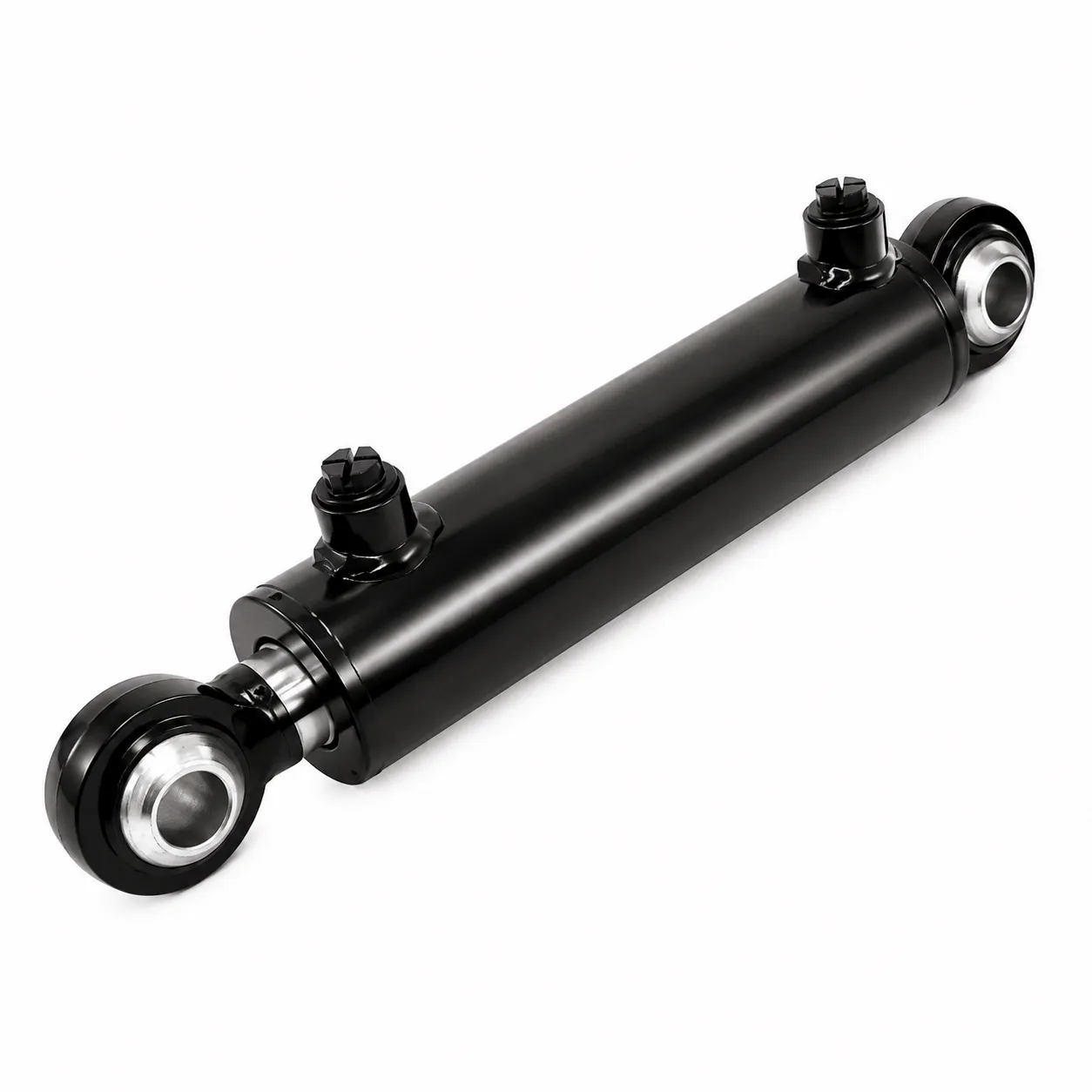
Ever Power: Manufacturing Capability & Customisation Service
Precision-engineered to your specification — not adapted from a catalogue
Ever Power operates dedicated hydraulic cylinder manufacturing lines equipped with CNC deep-hole boring machines, precision honing centres, hard-chrome plating baths, and robotic welding stations. The facility’s capacity allows concurrent production of standard catalogue items alongside fully custom engineering projects, meaning a bespoke steering cylinder order for a UK OEM does not push back lead times on standard replacement units for plant hire operators.
Customisation at Ever Power is not a sales phrase — it is a documented engineering process. Customers submit their existing cylinder drawings, machine OEM specifications, or functional requirements (force output, stroke, mounting interface, operating pressure). Ever Power’s applications engineering team produces a technical proposal within 48 hours, including material recommendations, seal options, and surface treatment choices. Prototype lead times for custom designs are typically 10–18 working days, with delivery via air freight to UK customers available as standard for urgent new-model development programmes.
Ever Power maintains buffer stock of common bore-diameter cylinder bodies and finished rod stock, enabling rapid fulfilment of repeat orders without the 6–8 week lead times that can cripple a UK plant fleet’s uptime during the busy spring and summer construction season. For customers with established annual volume agreements, consignment stock arrangements can be structured with a UK-based freight partner, placing pre-configured cylinders within next-working-day reach of any UK construction depot.
📩 Request a Custom Quote from Ever Power
Response within 24 hours — technical team available Mon–Fri, 08:00–18:00 CST
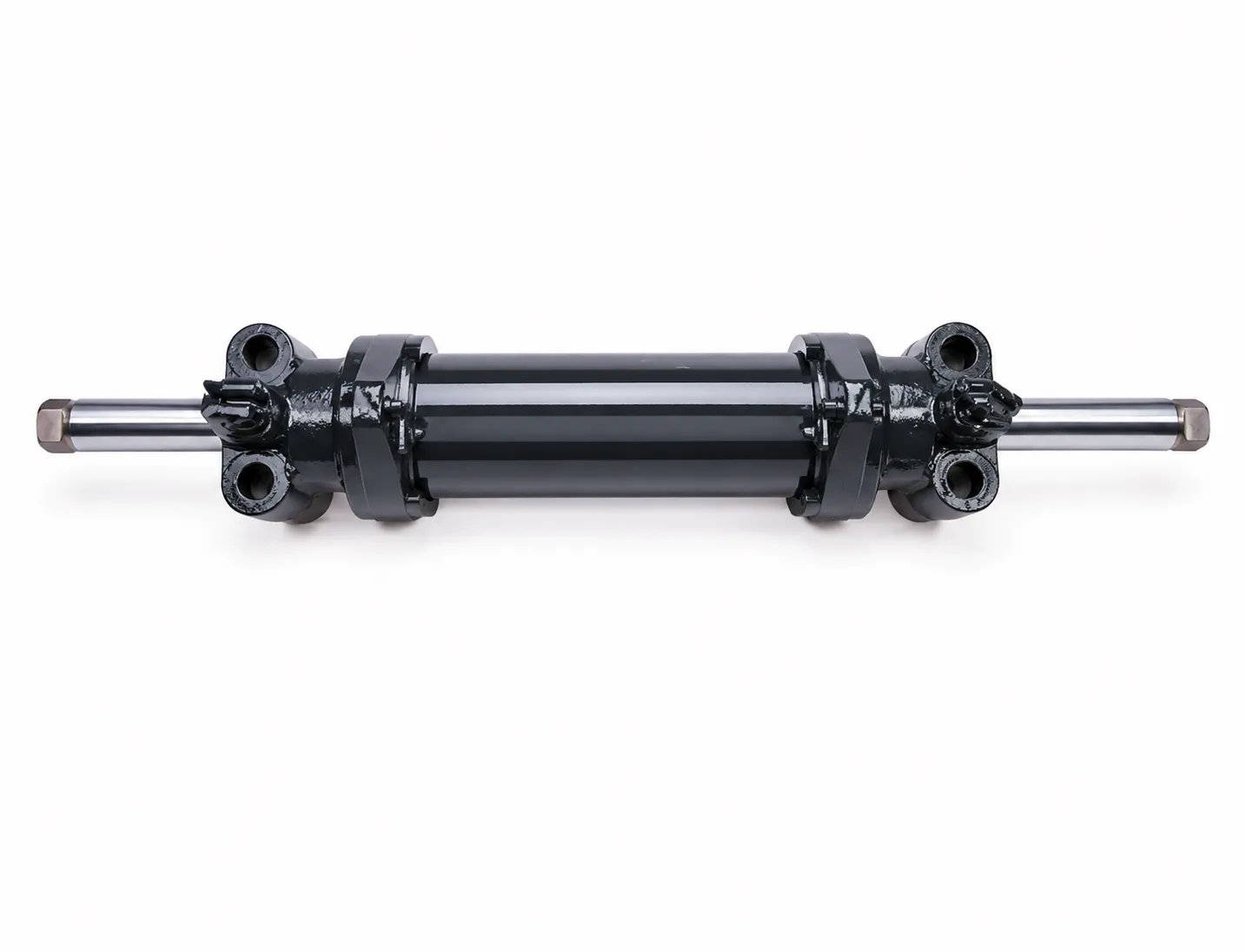
Customer Success: Sheffield Heavy Civil Engineering Contractor
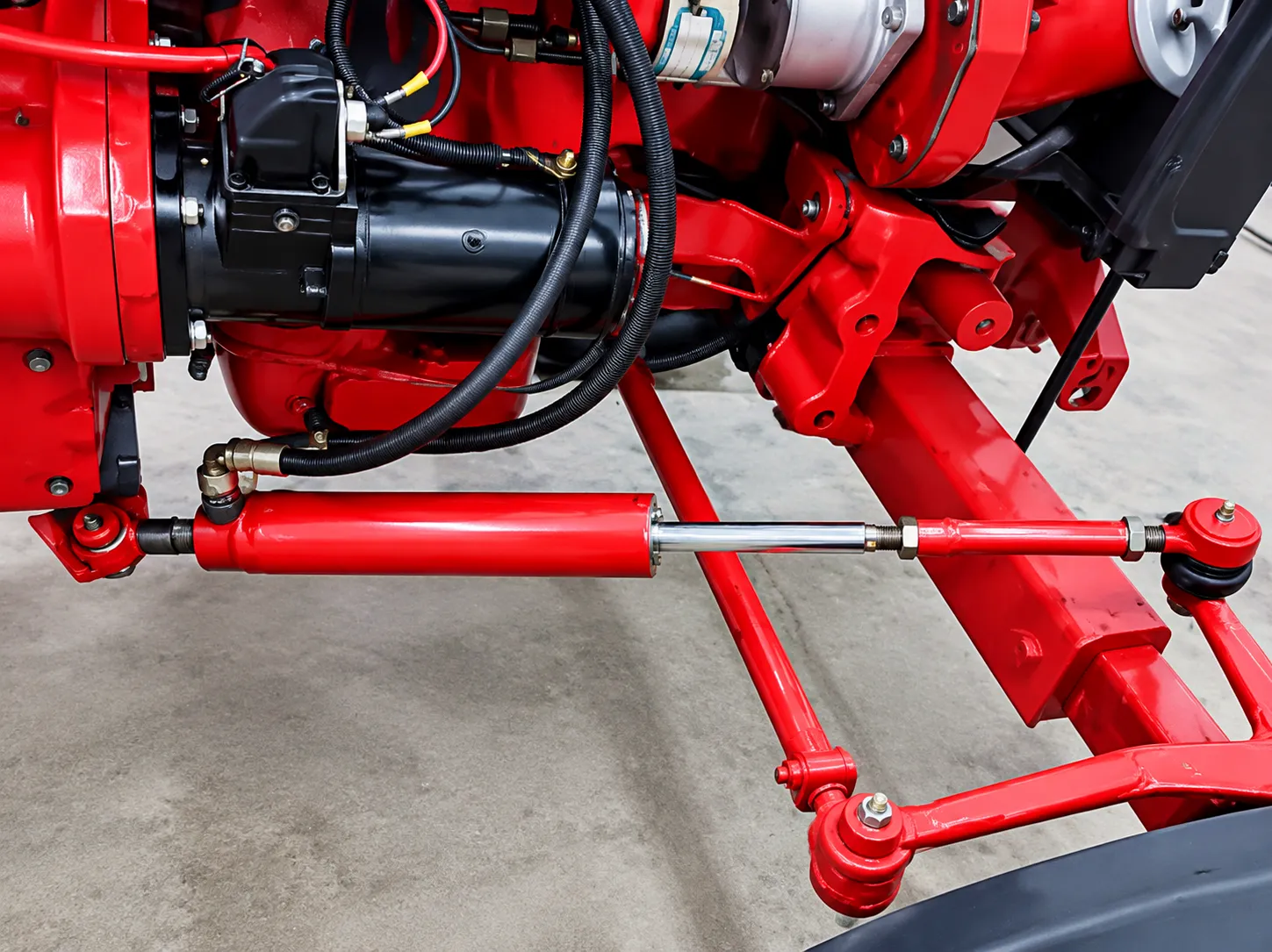 Meridian Civil Works Ltd, a Sheffield-based contractor specialising in deep utility excavation and civil groundworks across the Yorkshire and Humber region, was experiencing a recurring problem with the steering cylinders on three of their mid-size crawler excavators — 13-tonne machines used daily on deep-trench gas main replacement contracts. The OEM-supplied cylinders were failing at the rod seal within 800 operating hours under the demanding conditions of Sheffield’s clay-heavy geology, requiring the machines to be taken off contract for depot maintenance, at a cost the operations director estimated at £1,800–£2,400 per incident in combined parts, labour, and lost daily hire revenue.
Meridian’s plant manager contacted Ever Power after seeing a recommendation in a UK plant engineers’ forum. Ever Power’s technical team requested the full cylinder specification from the existing OEM units and reviewed the application conditions. The diagnosis was clear: the standard polyurethane wiper seal was allowing microscopic clay particle ingress that progressively scored the chrome rod surface, degrading the primary seal. Ever Power proposed a direct replacement steering cylinder with a metallic scraper ring added ahead of the standard wiper seal, combined with an additional 5 µm hard chrome thickness on the rod surface — a modest engineering change with a large performance impact.
Meridian Civil Works ordered a trial batch of six cylinders. Twelve months later, the service record was unambiguous: the Ever Power units had reached 2,100 hours of operation with no seal failures, and a scheduled inspection found only normal, within-tolerance wear at the rod seal interface. The lifecycle cost per cylinder dropped by 62% on a like-for-like basis. Meridian subsequently placed a framework supply agreement covering their entire fleet of eleven excavators, with consignment stock held at their Sheffield depot through Ever Power’s logistics partner.
What UK Plant Operators Say About Ever Power
“We went from budgeting for cylinder replacements every 700–800 hours to not thinking about them at all. The metallic scraper detail that Ever Power added was something our OEM supplier had never mentioned was possible. Two thousand-plus hours in, and the machines are running as tightly as the day we commissioned the swap. For us in Sheffield, where we’re digging through heavy clay on most contracts, that reliability is worth a great deal more than the price difference.”
“The documentation package Ever Power provides is genuinely impressive — hydrostatic test certificates, material compliance statements, the full works. When you’re buying hydraulic components for plant that needs to be CE-marked under UK Machinery Regulations, having that paperwork in order before the cylinder even arrives on site saves a significant amount of administrative effort. Their technical response times have been faster than most of our UK-based suppliers, which I honestly did not expect.”
“We operate a coastal dredging support vessel out of the Humber — an unusual platform that needed a very non-standard steering cylinder with stainless port fittings and Viton seals for compatibility with the fire-resistant hydraulic fluid we’re mandated to run. Ever Power handled the enquiry without any of the ‘we don’t do that’ responses we’d had from other suppliers. The finished product matched our drawing exactly, and it has handled the tidal and thermal cycling without a single issue through what has been a demanding winter operating season.”
Frequently Asked Questions
Questions UK plant buyers and procurement teams commonly ask about excavator steering cylinder specification and supply
Ready to specify the right steering cylinder for your excavator fleet?
Speak with Ever Power’s Engineering Team
edit by gzl