How Steering Cylinders Actually Work: The Engineering Behind the Force
The Hydraulic Circuit Loop
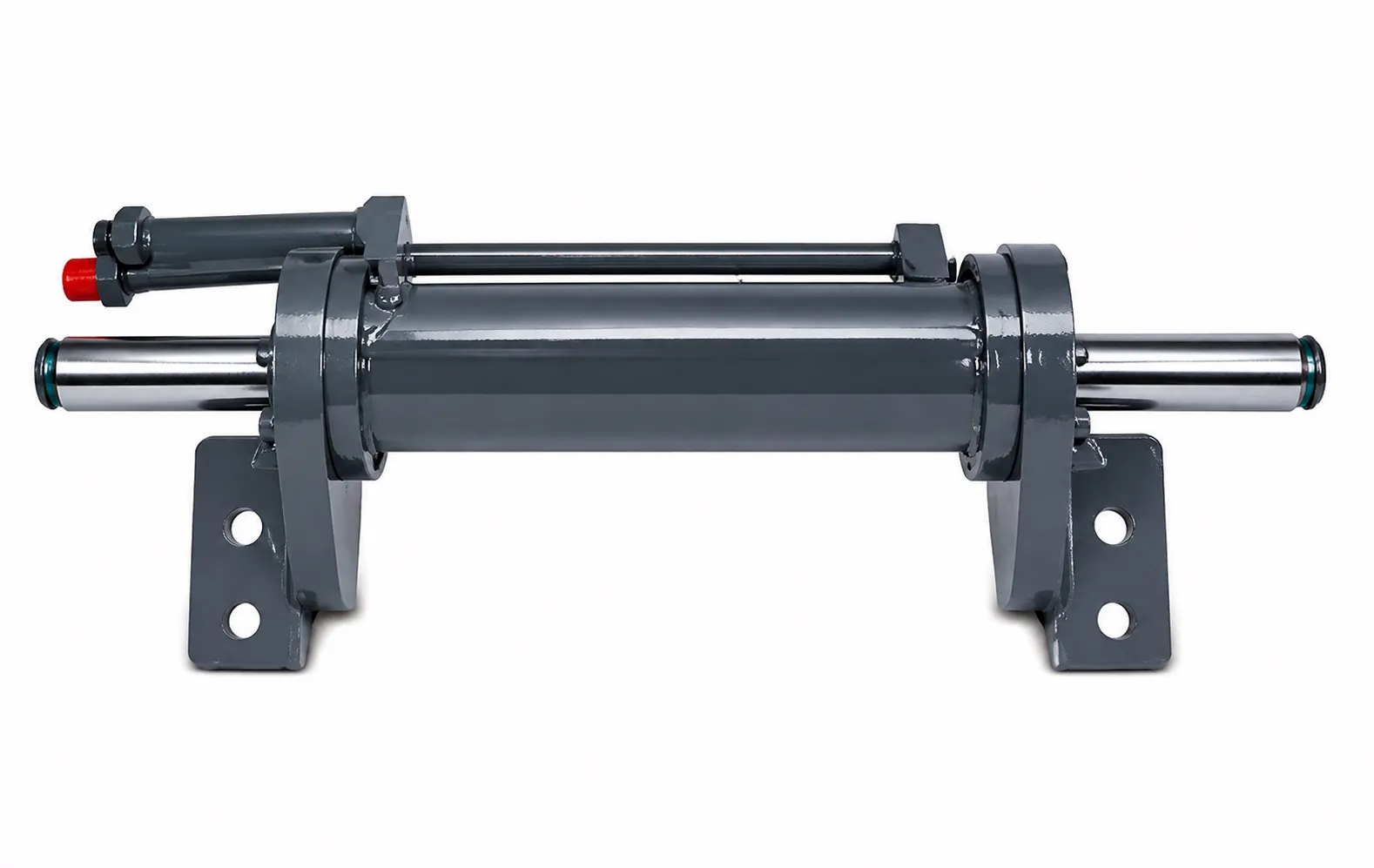
A steering cylinder operates within a closed-loop hydraulic circuit. The operator input — whether through a steering wheel, joystick, or electronic signal — commands the control valve to direct pressurised fluid to one side of the cylinder. On a double-acting unit, pressurised oil enters the cap end while the rod end drains back to tank, pushing the piston and extending the rod. When direction reverses, flow is switched: oil pressurises the rod end, retracting the piston. The pressure differential across the piston face multiplied by the effective bore area produces the output force — commonly expressed in kilonewtons. In a typical 80mm bore cylinder operating at 210 bar, the theoretical push force exceeds 100 kN, more than enough to articulate a 30-tonne wheeled excavator through a tight compound bend.
Single-Acting vs Double-Acting Configurations
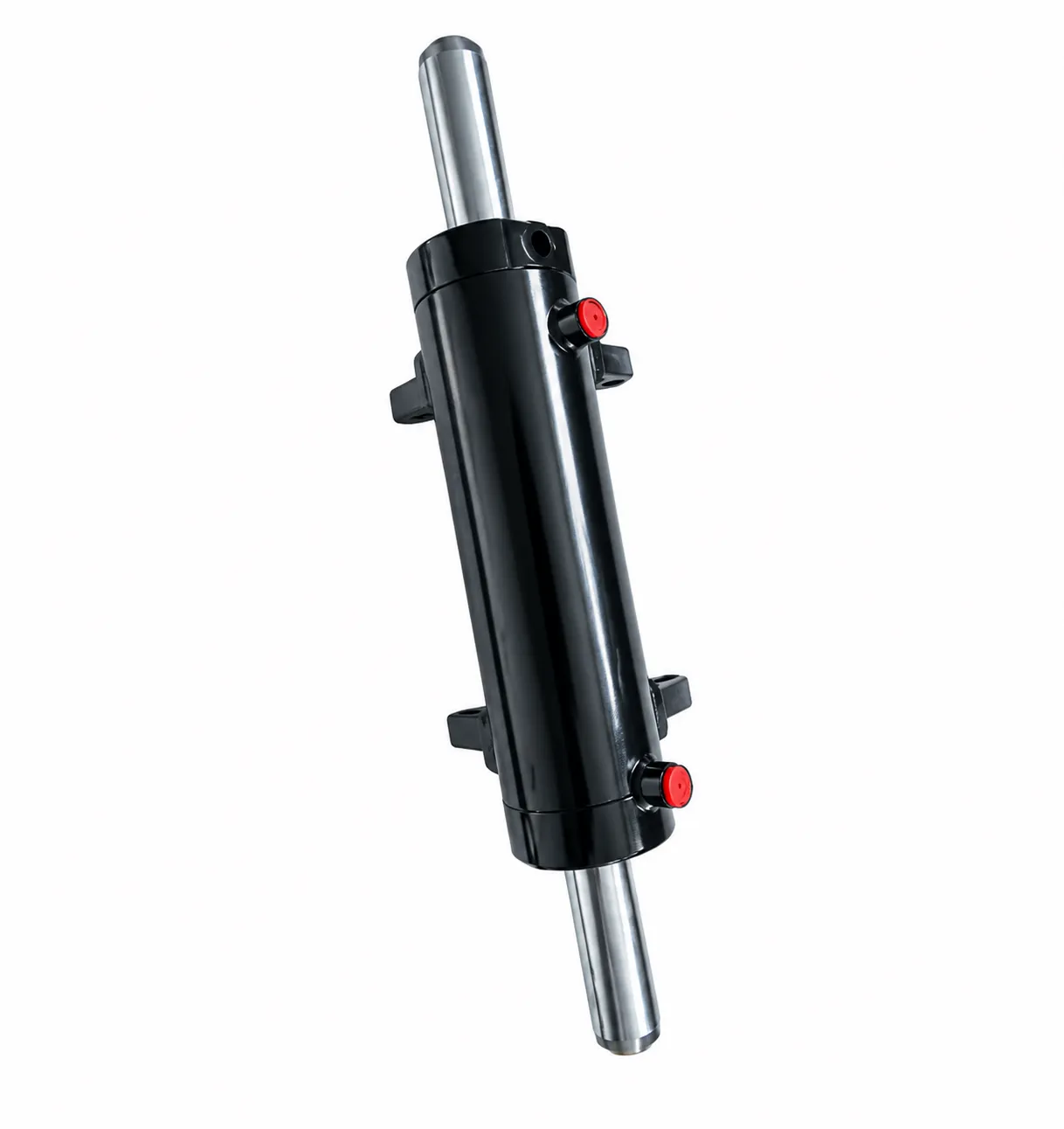
Not all steering cylinders share the same configuration. Single-acting units use hydraulic pressure for extension only, relying on mechanical springs or load return for retraction — suitable where one-directional force suffices, such as certain compact telehandler applications. Double-acting cylinders dominate heavy equipment power steering because they deliver positive control in both extension and retraction, enabling precise, proportional steering response with no dead band at centre. Many modern articulated dump trucks and large wheel loaders operating across quarrying sites in the Peak District and Yorkshire Dales rely on double-acting steering cylinders with integrated cushioning ports at both ends to absorb sudden shock loads when terrain becomes unpredictable, protecting the sealing system from water hammer damage that would otherwise reduce service life dramatically.
Force Transmission and Linkage Geometry
The steering cylinder does not work in isolation — its output rod connects to a linkage geometry, typically a steering drag link, a Pitman arm assembly, or an articulation pin arrangement depending on machine architecture. The quality of this kinematic relationship determines whether steering effort remains consistent throughout the full lock-to-lock travel. Engineers at Ever Power apply sophisticated simulation tools to match cylinder stroke, bore diameter, mounting configuration, and clevis geometry to the specific machine linkage, ensuring that the mechanical advantage remains acceptable across the entire steering arc. Poorly matched geometry causes uneven steering effort, accelerated wear at mid-stroke positions, and in extreme cases, steering cylinder side-loading that will prematurely damage rod seals and guide bushings — a common warranty claim avoided by rigorous application engineering.
Materials Engineering: What Goes Into a Heavy-Duty Steering Cylinder
Cylinder Barrel — Cold-Drawn Seamless Steel
The barrel forms the pressure vessel of the assembly. Ever Power specifies cold-drawn seamless tube manufactured to EN 10305-4 standard, typically in St52 (equivalent to S355J2) or the higher-strength 40Cr alloy steel for applications exceeding 280 bar working pressure. The interior bore undergoes deep-hole honing to a surface roughness of Ra 0.2–0.4 µm — a finish critical for seal longevity. Cross-hatch honing at 25° to 30° retains a microscopic oil film that both lubricates seals and protects against corrosive attack from water contamination, an important consideration for machines working in the wet and muddy conditions characteristic of UK construction sites from autumn through spring.
Piston Rod — Hardened and Chrome-Plated
Piston rods for heavy equipment steering cylinders face simultaneous demands of tensile strength, surface hardness, and corrosion resistance. Ever Power sources bars of 45# or 40Cr steel, forged and turned to tolerance, then induction-hardened to a case depth of 0.8–1.5mm with surface hardness reaching HRC 55–62. Hard chrome plating at 20–30 µm provides the final barrier against corrosion, abrasion from contaminated ingress around the wiper seal, and the mechanical scoring that would otherwise propagate leaks. For coastal and salt-air environments — relevant to port equipment operating along the Thames Estuary, the Humber, or the Port of Southampton — nickel-chrome duplex plating or electroless nickel undercoat is available as a premium option, extending service intervals considerably in aggressive environments.
Sealing System — Polyurethane and PTFE Composites
The sealing arrangement determines the cylinder’s ability to maintain pressure without bypass, and the quality of wiper seals determines how long the rod remains in serviceable condition. Ever Power configures sealing stacks based on application pressure, fluid type, temperature range, and cycle frequency. Standard configurations use polyurethane U-cup seals for the piston and rod, combined with PTFE-loaded guide rings that carry side loads and prevent metal-to-metal barrel contact. Where operating temperatures exceed 80°C — common in continuously cycled steering systems in high-ambient environments — FKM (Viton) seals replace standard polyurethane, maintaining integrity up to 200°C. The external wiper seal, often underspecified by lower-cost manufacturers, uses a hardened lip profile that actively scrapes particulate contamination from the rod surface rather than simply deflecting it, a meaningful engineering distinction in the muddy reality of UK groundworks operations.
Core Technical Advantages of Modern Heavy-Equipment Steering Cylinders
High-Pressure Rated to 350 Bar
Modern steering cylinders engineered for heavy equipment operate comfortably at working pressures of 250–350 bar, with proof pressure testing at 1.5× working pressure ensuring structural integrity. This high-pressure capability enables machine designers to achieve substantial steering forces from compact cylinder geometries, a critical advantage when integrating into tight chassis spaces on multi-axle heavy goods vehicles and large agricultural machines operating across the wide farming plains of Lincolnshire and the Yorkshire Wolds.
Extended Service Life Through Precision Honing
The bore honing process creates a surface that keeps seals operating in the hydrodynamic lubrication regime throughout service life. Cylinders with properly honed bores consistently achieve 10,000 to 20,000 operating hours before requiring seal replacement in typical heavy equipment applications. This extended service interval directly reduces maintenance costs and downtime — a compelling economic argument for fleet operators managing large inventories of plant across construction contracts spanning years at a time, as is common with major UK infrastructure projects.
Integrated Cushioning for Shock Absorption
End-of-stroke cushioning, achieved through tapered sleeves or annular grooves machined into the piston or cylinder head, decelerates the piston gradually rather than allowing abrupt mechanical impact. On rough terrain — quarry tracks, forest roads, or the unpaved access routes found on major civil engineering sites — these cushioning features protect welds, port bosses, and mounting pins from fatigue loading that accumulates over thousands of impact cycles. The practical benefit is dramatically reduced structural cracking incidents and longer overall cylinder body life, especially in articulated machines where steering inputs are frequent and terrain-induced shock loads are constant.
Corrosion-Resistant Surface Treatments
Beyond chrome plating on the rod, the external body of heavy-duty steering cylinders receives electrostatic epoxy powder coating or two-pack polyurethane paint systems applied over shot-blasted steel to Sa 2.5 standard. In salt-spray testing to ISO 9227, properly treated cylinders resist red rust formation for 500 hours or more — a meaningful durability measure for plant working through UK winters where road salt, slush, and standing water are ever-present threats to exposed hydraulic components. Trunnion and clevis pins are zinc or cadmium-free treated and greased on assembly, with grease nipples positioned for easy on-site re-lubrication without component removal.
Product Technical and Performance Parameter Table
| Parameter | Standard Range | Heavy-Duty / Custom Range | Notes |
|---|---|---|---|
| Bore Diameter | 40 – 100 mm | 100 – 250 mm | Custom bores available on request |
| Rod Diameter | 25 – 70 mm | 70 – 180 mm | Hard chrome plated, tolerance h8 |
| Working Pressure | 160 – 250 bar | 250 – 350 bar | Tested at 1.5× working pressure |
| Stroke Length | 100 – 500 mm | 500 – 1,500 mm | Custom stroke to ±0.5 mm tolerance |
| Operating Temperature | -20°C to +80°C | -40°C to +200°C (FKM seals) | Low-temp seals standard for UK climate |
| Cylinder Barrel Material | St52 / S355J2 seamless steel | 40Cr alloy / stainless option | EN 10305-4 compliant |
| Rod Material | 45# / 40Cr induction-hardened | Stainless 316 / duplex plated | Surface hardness HRC 55–62 |
| Bore Surface Finish | Ra 0.4 µm | Ra 0.2 µm (mirror hone) | Cross-hatch angle 25°–30° |
| Seal Material | Polyurethane / NBR | FKM (Viton) / PTFE composite | Parker / NOK / Hallite sourcing |
| Chrome Plating Thickness | 20 – 30 µm | 30 – 50 µm (heavy-wear grade) | Salt-spray tested to ISO 9227 |
| Mounting Options | Clevis / trunnion / flange | Side lug / spherical bearing end | Custom mounting geometries available |
Industrial Application Scenarios Across UK Heavy Equipment Sectors
Steering cylinders are embedded into the operational fabric of UK industry more deeply than most engineers appreciate until a failure event forces the point. The following sectors represent the highest-density applications in terms of unit volumes, replacement demand, and criticality to operational continuity.
Construction Machinery — Articulated Dump Trucks and Wheel Loaders
UK civil engineering and infrastructure projects — from the ongoing HS2 corridor works to major road improvement schemes managed by National Highways — demand reliable steering control in articulated dump trucks (ADTs) that carry 25–40 tonnes of material per cycle. These machines articulate through 45° or more at their centre joint, relying entirely on a matched pair of steering cylinders to control direction. The cylinders must handle both the deliberate steering input and the torsional shock generated when a fully loaded ADT hits a pothole or a drainage channel edge at speed. Birmingham-based plant hire fleets operating on Midlands infrastructure contracts report that steering cylinder service life is a primary determinant of machine availability, making specification quality a direct financial decision rather than a mere engineering preference. Products such as the forklift steering cylinder share engineering principles applied at scale in ADT applications.
Agriculture — Large Tractors and Self-Propelled Harvesting Machinery
The arable farming heartlands of East Anglia, Lincolnshire, and the Vale of York operate some of the UK’s largest agricultural machinery, including 400-horsepower plus tractors and wide-cut combines with GPS-guided steering systems that depend on precise steering cylinder performance. In precision agriculture applications, where auto-steer systems aim for centimetre-level accuracy across field passes, any internal leakage in the steering cylinder introduces positioning error that accumulates into overlapping or under-applied runs, wasting expensive seed and inputs. Modern agricultural steering cylinders must therefore hold near-zero bypass rates even after years of service — a challenge that requires exceptional seal specification and bore finish quality maintained throughout the manufacturing chain. Harvest windows are notoriously tight in the UK, with poor weather further compressing available working days, making machine reliability during the August to October period an absolute commercial priority for farm businesses.
Port and Logistics — Reach Stackers and Terminal Tractors
Container ports including Felixstowe, Southampton, and Liverpool operate reach stackers, empty-container handlers, and terminal tractors around the clock, often in salt-air environments that are deeply hostile to unprotected steel components. Steering cylinders on these machines must perform reliably through 24-hour shift patterns, handling tight manoeuvring through container lanes that leave essentially no margin for imprecise steering response. The combination of high cycle frequency, corrosive environment, and operational continuity requirements makes port equipment one of the most demanding application categories for steering cylinder engineering. Maintenance intervals must be long, and unplanned failures carry port operational implications that far exceed the direct cost of the component — creating strong procurement incentive for operators to specify quality over minimum unit price.
Materials Handling — Counterbalance and Reach Forklifts
Warehouse and distribution centre operations across the Midlands and the M1 corridor rely heavily on forklift fleets that cycle steering inputs hundreds of times per shift during goods receipt, storage, and despatch operations. In a counterbalance forklift, the forklift tilt cylinder works alongside the steering system to provide full machine control, while the steering cylinder itself manages the rear-wheel steering geometry that enables tight turning radii in racking aisles as narrow as 3.5 metres. Seal integrity in forklift steering cylinders must be maintained under conditions of variable load — a laden forklift exerts very different side forces on its steering cylinder than an empty return journey — and the compact installation envelope within the rear axle carriage leaves no room for cylinders with excessive outside diameters or non-standard port orientations, requiring precision custom manufacture.
Waste and Recycling — Compactors and Collection Vehicles
Municipal and commercial waste collection vehicles operating across dense UK urban environments — from London’s inner boroughs to Sheffield’s residential areas — navigate some of the tightest street conditions imaginable for vehicles of their size. Rear-steer axle arrangements managed by hydraulic steering cylinders allow these vehicles to track properly through tight corners without mounting kerbs or clipping parked cars. The chemical exposure from leaking refuse, the persistent wash-down cycles that drive water into any gap in external sealing, and the relentless cycle frequency of urban rounds all combine to create a hostile but high-volume application environment. Operators of large refuse collection fleets within UK local authority contracts increasingly specify cylinder overhaul kits by OEM part number, a commercial pattern that Ever Power supports through dedicated interchange referencing and seal kit supply programmes.
Ever Power: Precision Manufacturing and Global Customisation Capability
Ever Power operates dedicated hydraulic cylinder manufacturing facilities equipped with CNC deep-hole drilling machines, multi-axis honing centres, and automated welding stations that maintain positional accuracy within 0.05mm across all critical machined surfaces. The production philosophy rejects volume over quality: every steering cylinder barrel undergoes hydrostatic pressure testing at proof pressure before assembly, and finished assemblies are leak-tested with pressurised nitrogen prior to despatch. This rigorous sequence ensures that what arrives at the UK customer’s goods-in dock is ready to install and operate, not a component awaiting further inspection or rework.
Deep Customisation Capability
Ever Power’s engineering team works directly with UK machine OEMs and aftermarket customers to develop custom steering cylinders from drawing review through prototype approval. Inputs accepted include GA drawings, sample cylinders for reverse engineering, application specifications, or verbal technical briefs. Engineering outputs include 2D manufacturing drawings, material certifications, and material test reports — documentation packages that satisfy UK customer quality requirements from small engineering workshops to Tier 1 machine manufacturers with ISO 9001 quality systems.
Supply Chain and Lead Time
Standard steering cylinder ranges are maintained in finished goods and semi-finished stock, enabling 3–7 day despatch for common bore and stroke combinations. Custom and made-to-order units typically require 15–25 working days from drawing approval to despatch, a lead time that includes full material procurement, machining, assembly, testing, and surface treatment. For UK customers with time-critical plant-down situations, Ever Power’s expedite programme can compress standard lead times by approximately 40% through priority allocation and overnight international freight — reaching most UK mainland locations within 2–3 days of production completion.
Quality Assurance and Certifications
Ever Power operates under ISO 9001:2015 quality management certification with product test documentation available for each batch, including material certificates to EN 10204 3.1 standard on request. All steel materials are sourced from certified mills with full traceability, enabling customers subject to UK public sector procurement rules or OEM supply chain audits to satisfy their documentation requirements without additional material verification steps. Dimensional inspection reports, surface roughness measurement records, and pressure test certificates accompany shipments on request.
Customer Success Story: Sheffield Quarrying Operator Reduces Downtime by 60%
A medium-sized aggregate quarrying operation based on the southern edge of Sheffield — processing limestone and gritstone from a site that has been in operation since the 1970s — was running a fleet of six articulated dump trucks used to transport blasted material from face to crushing plant. The site operates year-round, including through the worst of the South Yorkshire winters when temperatures drop below -10°C and frozen ground produces particularly aggressive shock loads through the chassis articulation joint. The existing steering cylinders fitted as OEM standard were being replaced every 14–18 months, a consumption rate that the company’s plant manager, with 22 years of experience in quarry machinery maintenance, described as unacceptably high given the machine downtime and parts cost involved. Each replacement event required 4–6 hours of mechanic time plus crane assistance for the heavier machines, and sourcing OEM replacement units through the dealer network was routinely taking 8–12 working days — an eternity when a laden ADT is sitting idle during a production-critical period.
After approaching Ever Power’s technical sales team with dimensional data and application details, a custom steering cylinder was engineered that incorporated an upgraded sealing package with FKM low-temperature seals (rated to -40°C), an increased chrome plating thickness of 35 µm on the rod, and end-of-stroke cushioning sized specifically for the impact velocities recorded on this particular machine model’s steering circuit. The bore finish specification was tightened to Ra 0.25 µm to support the high-performance seal stack. Initial units were installed on two machines for a six-month evaluation period running through autumn and winter — the harshest conditions the site experiences.
The evaluation results were compelling. Over 26 months of continuous service following the initial installation — covering two full winter periods — neither evaluation unit had required seal replacement or showed any measurable bypass increase. The fleet was progressively converted to Ever Power steering cylinders across all six machines, and the plant manager estimates that the reduction in steering cylinder-related downtime and parts expenditure represents a saving of approximately £28,000 per year across the ADT fleet compared to the previous specification. Ever Power’s UK freight partner maintains ex-stock reserve cylinders at a Sheffield logistics hub, ensuring that any future urgent replacement can be installed within 36 hours of order placement — a service level agreement that has fundamentally changed how the quarry approaches steering cylinder inventory management.
What UK Customers Say About Ever Power Steering Cylinders
“We fitted four Ever Power steering cylinders to our wheel loaders working the Birmingham recycling site and they’ve been faultless for 18 months. The chrome finish on the rods has held up far better than anything we’ve used before — no pitting, no seepage, no complaints from the operators. The technical team at Ever Power answered every question we had about the seal specification before we committed to the order.”
“The customisation capability is what separated Ever Power from every other supplier we contacted. We gave them a sketch and a load spec for an unusual articulation arrangement on a bespoke timber extraction machine we’re building, and they came back with an engineered solution in four days. The cylinders arrived ahead of schedule, with full material certs, and fitted first time. The price was also very competitive for the level of engineering support included.”
“We source replacement steering cylinders for a port reach stacker fleet at Southampton. Ever Power supply us with units that match the OEM specification exactly in terms of envelope dimensions and port orientation, but at a price point that makes the procurement decision easy. The agreed stock programme means we carry zero inventory risk, and turnaround on urgent orders has consistently been within 48 hours. The quality of the bore finish is visibly excellent — you can see it immediately on inspection.”
Frequently Asked Questions
Common questions from UK plant engineers, fleet managers, and procurement specialists.
How much does it typically cost to replace a steering cylinder on a UK construction site’s articulated dump truck?
Replacement costs vary considerably depending on bore size, stroke, and whether a direct OEM replacement or a quality aftermarket unit is used. For a typical ADT class steering cylinder in the 80–100mm bore range, Ever Power’s pricing generally falls between £280 and £650 per unit ex-works, inclusive of full documentation. Total installed cost on site — including labour, crane hire if needed, and hydraulic fluid make-up — typically ranges from £600 to £1,400 per replacement event in UK market conditions. Requesting a quote directly from our team at [email protected] with your machine model and cylinder dimensions will yield an accurate price within one business day.
Which type of steering cylinder seal material is best suited for heavy equipment operating through UK winters in Birmingham or Sheffield?
For machines working through UK winters — particularly in more exposed locations like the South Pennines, Yorkshire Dales, or elevated sites around Sheffield and Birmingham’s surrounding districts — low-temperature polyurethane or FKM seal configurations are strongly recommended over standard NBR compounds. Standard NBR seals remain flexible to approximately -15°C, which is adequate for most UK conditions, but polyurethane provides better abrasion resistance and FKM extends the lower temperature limit to -40°C for the most extreme cold-start scenarios. Ever Power’s standard UK-market steering cylinders include low-temperature seal packages as default, with no additional cost or lead time implication.
Where can I find a reliable steering cylinder supplier in the UK who can provide custom dimensions and deliver quickly for agricultural machinery?
Ever Power serves UK agricultural machinery customers — including tractor OEMs, precision farming integrators, and farm machinery dealers — directly from manufacturing with freight transit times of 3–5 days to mainland UK addresses. Custom dimensional requirements for specialist tillage equipment, large-scale beet harvesters, or bespoke field machinery can be quoted within 24 hours of receiving your dimensional and pressure data. The harvest season time pressure is well understood by our technical team, and we maintain a dedicated agricultural equipment priority queue to ensure critical parts reach East Anglian, Lincolnshire, and Yorkshire farm operations before field windows close.
What causes premature steering cylinder failure on heavy plant, and how can UK fleet operators prevent it from happening again?
The four most frequent root causes of premature steering cylinder failure on UK heavy plant are: contaminated hydraulic fluid (particles damaging seals from within), inadequate wiper seal specification allowing particulate ingress from outside, improper mounting geometry creating rod side-loading, and operation at pressures exceeding the cylinder’s design rating due to incorrect control valve settings. Preventative measures include maintaining hydraulic fluid cleanliness to ISO 4406 16/14/11 or better, specifying double-lip wiper seals in high-contamination environments, having an application engineer verify mounting geometry before installation, and commissioning pressure relief valve settings during each rebuild or replacement cycle. Ever Power’s technical team can review application details and recommend the appropriate specification to avoid recurrence.
How do I get a competitive quote from a steering cylinder manufacturer for a fleet replacement order covering multiple machines at a UK port facility?
Fleet replacement enquiries from UK port operators receive dedicated account support from Ever Power’s commercial team. To receive an accurate quote, email [email protected] with the machine make and model, the number of units in the fleet, your existing cylinder part number or dimensional drawing, the annual consumption volume you’re looking to cover, and any delivery location requirements. Port operators placing orders above certain volume thresholds can access framework pricing, guaranteed stock reservation, and priority despatch arrangements. Multi-site framework agreements covering facilities at different UK ports — for instance, coordinating supply across Southampton, Felixstowe, and Liverpool simultaneously — are actively managed by dedicated key account support.
Ready to Specify the Right Steering Cylinder for Your Application?
Ever Power’s engineering team is ready to review your application and provide a technical recommendation and competitive price within one business day. UK fleet operators, OEM procurement teams, and plant hire companies welcome.